The stop loss industry is in a tricky position.
Rising healthcare costs are driving loss ratios up, which is forcing stop loss carriers to raise their rates.
In turn, higher rates make healthcare less affordable and less accessible, which is a lose-lose for everyone involved.
So in this episode, we’re focusing on key strategies to help keep costs low and rates affordable.
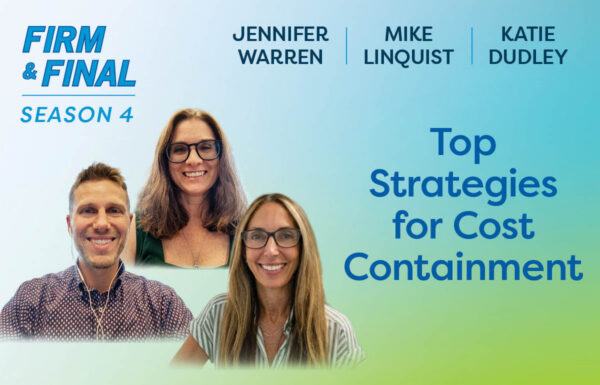
Joining us are Jennifer Warren, Mike Linquist and Katie Dudley.
They’ll help us explore cost-saving measures like subrogation, site-of-care change, and claims auditing—strategies that can be leveraged by employers, brokers, and even other stop loss carriers to increase accessibility and affordability.
Mehb Khoja
Hey everybody, welcome back to Firm and Final. This is the final episode of this season.
And I have to tell you, it’s all been kind of leading up to this conversation, which is going to be all about cost containment.
Basically this season, we’ve learned a lot about the issues in the stop loss and reinsurance market. And as we know, this has been a challenging year for the stop loss market.
And basically every conversation we’ve had this year has brought us to cost containment and keeping the costs as low as possible, making healthcare more affordable and accessible.
So I thought for this episode, it would make sense for me to introduce you to our cost containment and clinical team. So we have Jeni Warren and Mike Linquist with BCS and Katie Dudley with our MRM subsidiary.
So welcome to the show, guys. We’re going to get right into it. Jeni, just for the sake of the audience, give a little bit of your background and how you got into the stop loss space.
Jennifer Warren
I like to say I was born into this. My dad was the owner of an MGU years ago when I was 18, and he said, “You can’t sleep all day, you got to go to work. Come on.”
So I kind of grew up in stop loss.
Mehb Khoja
So you were literally born into this industry?
Jennifer Warren
Yes.
Mehb Khoja
And what do you do at BCS?
Jennifer Warren
I am the director of claims and clinical. So I oversee all the medical, accident and health, voluntary benefit claims. If it’s accident and medical related, it falls under my purview. And then I also help manage the clinical team and I’m always there for them when they need support.
Mehb Khoja
Awesome. Katie, how about you?
Katie Dudley
Sure. I entered the stop loss world in 2019. I took a contract per diem nurse role with MRM. I at the time was working in a NICU at a children’s hospital in Pennsylvania. I’ve been in NICU Nurse for 20 plus years now, and then in 2021 I joined MRM full time. And then last summer our clinical director retired and I assumed her role as the director of clinical.
And then earlier this year, I did step away from the bedside officially. I am just putting all my focus into being the Director of Clinical Services at MRM.
Mehb Khoja
You really like sitting behind a computer and a desk now.
Katie Dudley
Love it. It’s very different, but it’s good. It’s a good new challenge.
Mehb Khoja
Yeah, good. How did you get introduced to the stop loss world?
Katie Dudley
Actually from my aunt works for MRM. We had relocated from California back to the East coast, and she wanted to just show me what she did. She had reached out to me a couple of times about NICU babies and questions, and I looked into it and I was very intrigued, and I was ready for a new challenge.
And Mehb, you were president of MRM at the time I was hired, and it was a great pivot for me.
Mehb Khoja
Awesome. Mike, how about you?
Mike Linquist
My background is actually clinical. I spent years working in neuro and medical ICU, and I actually got into stop loss kind of by accident.
I was buying a used car in Saint Pete, ironically, and it was an Altima, right. And I also, I ended up buying a Rogue as well, it was a two for one used car dealership.
Mehb Khoja
You like Nissans!
Mike Linquist
Yeah, someone who worked – Yeah, right? Someone who worked at the dealership. It was actually the fiance of the person that owned it came in, because we bought two cars, to celebrate and she happened to work for a company, and they said they were hiring nurses for stop loss clinical assessment. And I said, “What is that? I have never heard of that.”
And yeah, I applied for a job at that small company, and I worked there for a couple of years as a contractor, really figured out how to manipulate documents and look through things. Totally different workflow than ICU nursing. But, you know, ICU nursing did come in handy when looking through medical claims and everything. And then, yeah, I ended up finding BCS through a job posting online.
And yeah, the rest is kind of history. I’ve been here for three years. I started as just a stop loss risk clinician doing what I did before. And then now I have been the manager of the clinical department and building that workflow into everyone that comes into the company that’s going to be part of the clinical team.
Mehb Khoja
Awesome. So guys, look, when stop loss loss ratios are not doing well, the stop loss world, because we’re all financing vehicles, we have to raise our rates.
And that makes healthcare less affordable, less accessible. And so our jobs are to figure out ways to keep costs as low as possible.
So for today, I just want to focus on the key strategies you guys see that can help policyholders keep their spend low.
Because when their spend is low, that makes for lower rate increases. And it creates a sustainable client for us and a good solution for them.
So Jeni, I’m going to put you on the spot. What is your top strategy that you see very useful for employers when it comes to saving dollars on stop loss?
Jennifer Warren
I’m a big proponent of subrogation. I feel like there are so many dollars left on the table, and they don’t think it’s just car accidents. You have to think beyond that. It’s any accident.
It could be a post op infection that turns into a lawsuit. Maybe there was a never event and it should never have been paid. So I am a strong proponent of subrogation and having strong subrogation language.
Mehb Khoja
So maybe just for the sake of the audience, explain what subrogation is. What does that term even mean?
Jennifer Warren
So if you’re in a car accident and you have to go to the ER and you need medical care, the insurance company is going to pay for that. Your medical insurance company is going to step in and say, “We got it. It’s fine. We’ll pay for it. Just tell us what happened.”
And then if you get a lawyer and you want to go after the people that hit you, or the insurance companies are going to argue over who’s responsible for the accident, then it becomes a subrogation issue, and you really need a good subrogation vendor to go in there and say, “I’ll follow this. And if there is any lawsuit or any recovery or anyone gets money back, I’ll make sure you get your money back.”
Mehb Khoja
So there’s multiple insurers that could be involved in a claim. Sometimes it could be the auto insurer, sometimes it could be the homeowners insurer. And even though something happens and you had a medical claim, there could be a second payer that could be first liable to pay those claims. And if we knew that, then perhaps a stop loss claim ends up not being a stop loss claim. Is that basically how it works?
Jennifer Warren
Yes, that’s how it works. And we have seen this year where claims should not have been paid because subrogation recoveries came through and they were just never followed.
Mehb Khoja
So how does that even get triggered? Like if I had one of these types of medical claims, how would anybody know that another payor could have even been involved?
Jennifer Warren
So it takes a little bit of digging through your claims detail. It takes a little bit of investigation. Was there multiple fractures? Was there a traumatic brain injury? Was there a sustained sepsis ICU stay that maybe could have been a post op infection that shouldn’t have happened.
And then it’s a conversation with the plan or the broker or the administrator, whoever, and saying, “Hey, I think we need to investigate this a little bit. I don’t know if we should be paying for this.” And then it’s turned over, right? You pay your dollars out and you make the company whole because you don’t want your employers not whole.
And then it becomes sending it to a vendor to follow, and they will chase it down for you and they will say, “Hey, there’s no recovery here. No one’s suing anyone, no one’s at fault. It’s just that was a true accident.”
Or they’re going to say, “Hey, we should be following this one. I found a GoFundMe for them that describes everything out there that happened to them.”
Mehb Khoja
So, Katie, do you guys come across that at MRM? Do you see subrogation opportunities on that side of the business?
Katie Dudley
Yes. I feel like from a clinical standpoint, when doing a clinical review, I feel like we would be made aware if a subrogation or we would question it, we would write that in our clinical review, questioning if this was a subrogation to dive into and dig into a little bit further.
Mehb Khoja
Yeah. And what do you guys find, I invite any of you guys to answer this, what do you guys find is like the success rate when we bring in a subrogation vendor to help us on a claim?
Jennifer Warren
I think we’re in the 80s to 90%.
Mehb Khoja
Oh, that’s pretty high.
Jennifer Warren
I’ve seen very aggressive vendors. And they follow it. They follow it from day one. There’s long tails to them. They take a long time. They’re pretty aggressive and pretty persistent.
Mehb Khoja
Interesting. Mike, how about you? What’s another strategy that we as a stop loss market can utilize to keep claims low?
Mike Linquist
So one of the big ones is site of care, especially for specialty infusions. Namely for example, one of the bigger ones that we’ve seen in the last year or two is Keytruda. That’s a big one. Also other high cost chemo drugs.
We had one situation where Keytruda was being billed at $56,000 every three weeks. It’s a drug that gets given every three weeks.
Mehb Khoja
In the hospital?
Mike Linquist
Yes, it was being given in the hospital, that’s right. $56,000 every three weeks. And just through site of care change, meaning taking that same drug and moving it to another site outside of an inpatient hospital setting to an outpatient site of care, that’s the site of care change, we were able to get that drug down to $16,000 every three weeks.
Now, if you do the math, every three weeks, that’s 17 infusions for the year. It works out to about $700,000 annually. And that drug continues to be given until progression of the disease or toxicity. So the patient can be on that drug for two, three, four years. I mean, they could be on it for a long time.
So you do the math, it can add up to a couple million. So that site of care change is a big one because it’s the same drug, different setting, and the different setting is a drastic difference in the cost.
Mehb Khoja
So the site of care change, this was on one of our policyholders. Is this something that could be utilized like during the new business underwriting process? Like if you see something like this, is there an opportunity then to change the site of care on a new business case?
Mike Linquist
That’s a good question. On a new business, it is definitely a lot harder because you have, of course, a lot of moving parts and with a lot of moving parts and parties involved, you have a lot of walls before you even get to the decision maker, the employer group.
So for a stop loss carrier perspective, we have broker, we have TPA, and then we have the actual decision maker the employer group.
So when you’re trying to bid a new business opportunity, you’re usually put up against a couple other competitors, other carriers. So the only way you can really utilize or implement something like a site of care change is to make it somewhat conditional. And that’s definitely a difficult thing to do from a new business perspective. So we’ve definitely had some challenges implementing site of care change on a new business perspective quote.
Mehb Khoja
But on a policyholder, we probably did something with like the renewal, right? We probably staggered the renewal increase or something to that effect, maybe changed how we would handle a laser or something to that effect.
Mike Linquist
Yeah. So for groups that we are renewing that are already with us, and we have account managers that already have relationships with those employer groups and TPAs. That relationship’s already there so we can communicate with them. And yes, it will have an effect on it could be the renewal rate and lasers and multiple different things just depending on what they decide to negotiate.
Mehb Khoja
Yeah.
Jennifer Warren
Well you would have a benefit experience reduction right. If the dollars are coming down organically through site of care change, you’re going to have a benefit experience reduction in those rates.
Mehb Khoja
Yeah, absolutely. And I mean we’re talking about stop loss. So it’s like 3 to 4 claimants per year on the average policy. So if you can make an impact on even one claimant, that’s the difference between renewing it at a very low rate increase versus having to max out the renewal rate cap, potentially even add a laser.
Those are the things that are causing employers a lot of heartburn. It’s causing the brokers a lot of heartburn right now too. Katie, how about you? What’s the strategy that you like to utilize to save money?
Katie Dudley
Sure. One that I have done personally for MRM was auditing a NICU bill claim in the past and really just digging into that claim detail and seeing if there’s unnecessary claims, duplicates, things like that, because I feel like there’s a big opportunity to save money in errors that we find.
An egregious claim that MRM came across years ago was a member receiving multiple back surgeries within a few months. And then after doing some more digging, the physician in Florida was actually under investigation for performing unnecessary surgeries. And then that-
Mehb Khoja
Oh! Fraud!
Jennifer Warren
Yeah, that claim was denied and then never appealed. So I feel like it’s very important to do claim audits and bill audits to ensure there’s not egregious claims or duplicates or extra charges on there.
Mehb Khoja
Okay. So when we do those types of audits, what type of errors are we typically finding?
Katie Dudley
I feel like duplicate charges are a big error that we’ll find. And also sometimes the unbundling of claims. If there’s a room and board charge for a person being inpatient in a hospital, and then there could be excessive other claims billed to that claim detail that should have been included in the room and board charges.
Mehb Khoja
Yeah. And Jeni, we come across that at BCS as well. When we run these audits, we’re finding all types of duplicate charges.
Jennifer Warren
Yeah, unbundling is a big thing. We’re seeing a lot of unbundling, a lot of not stepping down of the room care room units. Like if you have NICU level four, they should have been a level three and they’re just not doing it or they’re not billing it appropriately.
Mehb Khoja
So here’s a question for all of you guys. How do you find these opportunities to do an audit? When do you decide this is a claim that we should go audit?
Jennifer Warren
I have a dollar threshold. I don’t want any dollar paid over a certain amount without being reviewed.
Mehb Khoja
Okay, Katie, what do you guys do at MRM?
Katie Dudley
I feel like, being on the clinical side of this when we’re doing clinical reviews, if we come across as Mike was talking about, an egregious charge for Keytruda or another drug, and seeing if it’s the drug charge, if there’s a site of care that could be changed, something to bring our attention to that and investigate it further.
Mehb Khoja
Yeah, Mike do you have any thoughts on this?
Mike Linquist
Yeah, I have one thought to offer. I was reading a book and it said that up to 80% of medical bills contain errors, which I thought was a pretty crazy statistic.
And apparently 25% of the $1.6 trillion of apparently medical waste that’s from the JAMA Association, 25% of that or $420 billion annually is from billing errors and fraud.
And like I said, 80% of medical bills contain errors. So that is pretty self-explanatory. There’s definitely something going on with fraud, errors. And it needs to be looked at closer and more often. And mostly you do find something like Katie and Jeni both said upcoding, unbundling, services not rendered.
All those kinds of things, they’re out there and they’re happening quite often and the amount over what reference-based pricing costs is insane. It’s just insane. So I think there’s a lot of opportunity in medical billing errors alone.
Mehb Khoja
So as a stop loss carrier, is there something more that we could be doing? I find that we are in a marketplace where a lot of times we’re just the financier and we get told to pay that claim. But is there something more that stop loss carriers could be doing to help keep the costs as low as possible for policyholders?
Katie Dudley
I feel like educating their employers and TPAs, you know, and making sure that people are using vendors and cost containment initiatives when applicable, there’s a room for growth in that area. Coming from the bedside it was really eye opening to me to see how vastly different plans pay for the same exact care.
That was just a bit mind boggling to me. I didn’t realize, you know, being on the other side of it for so long that this was going on.
Mehb Khoja
Yeah. And now with price transparency data, it’s like you can figure out how much each payer is paying for that same service, same location, same sort of patient. And there’s a wide variety of payments. Jeni, how about you?
Jennifer Warren
I think it’s a conversation. I think there needs to be more pushback and have the brokers and the administrators on board, and it’s just going to be a fight uphill with these providers.
Mehb Khoja
Mike, anything to add?
Mike Linquist
Yeah. So I think there’s two different prongs here. The first prong, if I was talking directly to like an employer group would be, and this is a Warren Buffett quote that I really liked a lot I read recently. And it was when he was working for GM and he said, “We are an insurance company that sells cars.” And I thought that was so interesting. And also it was echoed by Mark Cuban recently when I was listening to another podcast.
And basically every company is an insurance company, and it’s a good perspective for an employer group to have. It’s usually the second biggest payable item after payroll is your health cost. So every company, whether you like it or not, you’re a health insurance company.
And that means that you have to start managing your claims. That means there’s a lot of topics to learn and talk about, and get people in house who know how to administer, like TPAs in-house that know how to do this stuff. Look at a better PBM, broker compensation, bill reviews like we’re talking about, direct contracting, all kinds of different strategies.
But the main thing is to employers that you’re an insurance company, whether you like it or not.
And then secondly, to brokers and TPAs, to make the communication channel between stop loss carriers and the end employer group easier, because there’s a lot of barriers. Stop loss carriers, we’re doing these bill audits and things, and it’s really hard to get to the end employer group.
But you know it’s a win-win for everybody. If the broker can come with a good solution to the TPA and the employer group, that saves a lot of money. It’s a win-win scenario.
So we’re not the enemy here. Everybody wins if we can start implementing some of these cost containments. So my message there is just make it easier for the communication to exist between the employer group and the stop loss carriers. That would be great.
Mehb Khoja
Yeah. That’s great advice. Maybe let’s just share a story with our audience about a particular claim you guys came across. Maybe it was a very egregious claim, or maybe it was one where we were able to implement some of our cost savings initiatives. Jeni, how about you go first?
Jennifer Warren
Years ago, we had a baby and the baby was in a major facility, well known. We sent it out for bill review. It was a typical baby, but the billed charges and the paid amounts were just so high. It wasn’t a typical baby, right? It was multi million dollars and we sent it out for bill review. And bill review found tons of unbundling and it was work. It was work to get that money back. But NICU, you know, NICU is real.
Mehb Khoja
Yeah. Those are those are tough claims. And those are typically discount off of billed charges and a very low discount.
Jennifer Warren
Yeah. And no one wants to tell a parent like your child’s care was wrong.
Mehb Khoja
Katie, how about you?
Katie Dudley
I mean, kind of touching on what I stated earlier about the back surgery. I found that that was probably one of the most interesting ones, and just that in our clinical team, we have enough clinical experience to know when a procedure doesn’t match a diagnosis, which I think is really important in doing our clinical reviews, and that if somebody is having multiple back surgeries within a few month window, there’s red flags that are raised. And to dive a little bit deeper into that and figure out what’s really going on.
And in this case, it was a physician who was already being investigated. And then the claim was never appealed.
Mehb Khoja
You know, it just reminds me of probably the most egregious claim that I saw. This is back to maybe 2019, when I was at MRM.
We were hired to do an underwriting audit for a client, and part of the files that we looked at, we saw in total two patients over two years, $40 million in charges.
And the claimant was a mother and daughter. They both had hereditary angioedema and they were getting prescribed every HAE drug that’s out there, like multiples of them. And it just didn’t seem right. And it looked as if it was fraud.
Luckily for this underwriting audit that we did, that client didn’t end up writing that group, but they had looked at that group as part of their new business underwriting. And so we audited their processes. So we were able to see that.
I came to learn later on that that situation was part of like a major stop loss lawsuit that was fought in the courts for several years because the stop loss carrier was really pushing back on what they felt like was fraud.
And I think that they were probably right. $40 million over two years is just a lot of money.
Now, the interesting thing about that one is there’s now a gene therapy that is in development for hereditary angioedema, which will cost a couple of million dollars at some point, obviously it’s not out in the market yet, but there’s a lot of these types of claims that are out there.
I think for today, I’m glad that we were able to touch on a few strategies that employers, brokers, and even other stop loss carriers can utilize. So we covered subrogation, we covered bill audits, and we covered site of care changes, because these are all ways that we can help save expenses for the policyholders. And when we do that, we’re helping to make healthcare more accessible and more affordable.
So we’ll close it up there for today. Thanks for joining for this edition of Firm and Final.
Listen on:




About the Podcast
Firm & Final: The Legends of Stop Loss and Reinsurance is an award-winning stop loss industry podcast from BCS Financial Chief Operating Officer Mehb Khoja. With a new focus each season, Mehb brings together members of the stop loss, reinsurance, and self-funded industries to discuss current and future stop loss issues and trends, and share legendary experience and advice for the next generation of stop loss and reinsurance superheroes.

Record and submit your question at [email protected] to be featured on a future episode!
Podcast hosted by Mehb Khoja: linkedin.com/in/mehbkhoja
Firm & Final Podcast
"*" indicates required fields