“Buy healthcare better.”
That’s the guiding philosophy at benefitSMART, an innovative cost-containment solution for the healthcare business that is making headway on one of the industry’s biggest problems.
The consumption of healthcare is primarily a passive experience for most customers. And, from the standpoint of healthcare as a commodity, it is sold more often than it’s bought, leading to rising costs.
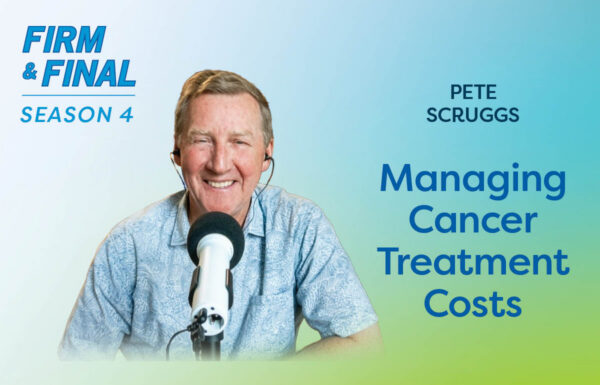
So in this episode, we are joined by Pete Scruggs, the founder and CEO of benefitSMART Cancer Solutions.
benefitSMART is a patient-first health solution founded in 2020 that works within self-funded health plans to lower cancer and specialty care costs through site-of-care optimization and patient advocacy.
We’ll discuss how their cost containment strategies are changing the way healthcare is bought and paid for, the importance of building trust with the patients you serve, and the evolving role of brokers and stop loss carriers in managing healthcare costs.
Mehb Khoja
Hey, everybody, welcome back to Firm and Final. I’m your host, Mehb Khoja.
And today I have with me Pete Scruggs.
And Pete, I got to tell you the most important topic in all of stop loss right now is cost containment. And, Pete, you and I met for the very first time about a week and a half ago at the AMS conference. But in full disclosure, BCS, the company that I work for, is a utilizer of the company that you work for and you founded benefitSMART.
I think just to get us started, give the audience a little background as to what benefitSMART is and what you guys do.
Pete Scruggs
Thanks Mehb, very excited to connect with you.
So benefitSMART is really answering the question of how do we manage the cost of cancer treatment. And it’s designed to work for all those parties who are paying for cancer treatment, which is really the three are: the employer, stop loss, and ultimately the patient. And so what we’ve done is out of our about ten-year run of experience, have built a solution that works for all three of those parties in regards to how cancer is paid for.
And we call it health care purchasing. So it’s really built to manage the cost of cancer treatment, and it requires all three parties to care and to buy in and to move forward for it to be successful.
Mehb Khoja
You bring up a topic here that’s really peaking my interest. You said the employer, the stop loss, and the patient. I would probably add one more payer to that mix, which is the reinsurer.
We’re at a stage here where claims are exceeding one million, two million dollars, and there’s multiple payers involved. And I think you guys have a focus on the patient first and then everybody else benefits downstream from that.
How did you get into this space? Where did you find the business opportunity? What kind of got you going in this direction?
Pete Scruggs
Well Mehb, my background is in being a health care consultant in the Pacific Northwest. So this program really started in a deeper and wider way of solving for the same issue for employers, that there’s just a wide range of things that are very expensive.
So our program is a direct contracted approach. We own the contracts, we hold the contracts, which allows us to have very close relationships with the clinics that partner with us, and we’ll get back to that later.
So we realized that if care goes to a hospital for a colonoscopy, it might be $4,000. It might be $1,000 locally. Same with imaging, orthopedic surgery, knees, shoulders and the most challenging one, even immediately ten years ago was oncology. And you know, there’s many reasons for that.
But what we decided to do was to build a proactive approach to these processes. And, you know, it was somewhat novel at the time, but we started small, you know, one contract at a time. This is something that we rolled out to our employers in the Pacific Northwest.
And about six years ago, I had a friend of mine ask me if we could help him with his clients in Texas. And, we really had no intention of making a national program. But we stepped in and said, yeah, we’d build some contracts for one of our clients that had locations in Houston and Dallas, and one thing led to another, and here we are in 50 states.
Apparently, the problem in Portland, Oregon, Vancouver, Washington is the same as it is in Dallas or New York City or Miami or Los Angeles or, you know, small towns in between.
And so it really started out with just a holistic approach to purchasing healthcare better.
Our philosophy was “buy healthcare better.” And when you break that down, those three words, it’s kind of saying something from our philosophy is that we think the healthcare is primarily sold rather than bought. And it’s a very passive experience for most people.
So we tried to turn that on its head and purchase really great contracts and then connect that to patients in ways that the patients would view it as a positive for themselves. We knew it would work for the employers and the upstream payers, stop loss and reinsurance. The real challenge was would patients see it as a positive for them?
And that’s really when we won the day at that level is when the program took off.
Mehb Khoja
Yeah, that’s really interesting: “buy healthcare better.” Why does healthcare need to be bought better when there’s these payers that are out there that are much bigger than you are?
Why are they not able to contract at better rates than what you have been able to achieve?
Pete Scruggs
I feel compassion for them, to be honest. Mostly. You know, when you look at a hospital, by definition our work is typically non-hospital other than for surgery. You know we do have a rising tide of, we did a bone marrow transplant surgery in Dallas two weeks ago. Very expensive. And for that procedure we did need not just our clinical partner but we needed a hospital partner.
But in general our work is non-hospital partners. And the hospitals by definition really do, I’m not being sarcastic, I think they really do need to charge about 3x what an independent clinician can charge, because their cost structure is just so much higher.
Now, you know a more cynical person might say, well, there’s some nice profit taking as well in those hospital settings and I’m sure that that’s part of it.
But they do have a lot of issues to deal with that smaller clinics don’t have to deal with. But the definition of savings is really the site of care change from a hospital setting to a non-hospital setting. We do contract with excellent rates, but a lot of it is also just in that site of care change.
Mehb Khoja
Yeah, and like I mentioned before, full disclosure BCS is a utilizer of your company’s services. We’ve definitely seen that savings. And I would say that cost containment is probably the hottest topic in all of stop loss and reinsurance right now.
You specifically mentioned cancer care. Does your services go beyond cancer care?
Pete Scruggs
It does. You know, the reason that we led with benefitSMART Cancer Solutions as our brand is that it’s the most difficult part to solve for. But once you’re working with an employer on a cancer scenario, the statistics are going up. But it may be, you know, somewhere around 2 to 3 people out of a population of 1,000 that have cancer.
But there’s many more that would have very high cost autoimmune conditions. A lot of the cancer treatments are now going to orals or self injectables. So we’re really anywhere in that chain of high cost procedures for the employer.
Now, full disclosure, we do have expertise around surgery. That’s really where we started ten years ago. But we’ve just been so busy, you know, driving through on the cancer solution that we’re really accepting a kind of exceptional circumstances.
We don’t really do surgeries, but anything high cost drug and certainly cancer’s unique in that it’s a four wall experience for most people. So you can buy Keytruda, anybody can buy Keytruda as a cost containment partner for a good price, but you can’t get it dosed because you don’t control the script. You don’t have the relationship with the provider.
And so I would say many of our competitors in this space think that it’s as simple as buying the drug cheaply and then forcing it on the hospital through a white bag scenario, but that’s kind of diminishing returns I think in this industry.
We like to call it a coalition of the willing. And the partners that we work with want to work with us, choose to work with us. And we think that’s more of a durable solution.
Whereas I think some of the cost containment programs out there really are kind of more of a win-lose. I may win by forcing the drug into your hospital system, but you’re losing, you know, as a hospital. And so we think a more durable program is a win-win solution.
Mehb Khoja
So Pete, maybe taking this a bit of a philosophical turn, but I’m curious from your perspective, how the heck did we get here where self-insured employers and other payers need cost containment vendors? How did the costs get so high?
Pete Scruggs
Yeah, you know, I think well, it’s interesting to your point of networks that you mentioned earlier, many networks are percentage discount off of billed.
I’ll give you a good example. We worked on a case in Chicago a while ago, and the savings on Keytruda was probably $80,000 per claim. And when I asked the ASO leader who was involved in that, you know, he didn’t know I was talking about that case, but I asked him, why in your system would we have anomalies like this?
He said, you know, we’re a percentage of billed discount. So if they bill $2 million and we have a 50% discount, then that’s why you end up with $1 million cost rather than a $250,000 cost.
And so I think the percentage of billed scenario really is kind of creates this, this undisciplined approach to purchasing healthcare.
Mehb Khoja
Yeah. And we see that across a lot of payer provider contracts that discount off of billed is a predominant payment methodology. And so that just opens up a lot of opportunities for your sort of cost containment solutions.
I’m curious Pete, what are some other cost containment solutions that are out there that you feel like are working for self-insured employers?
Pete Scruggs
You know, I would say that what we see a lot out there is we do see reference-based pricing as a methodology. Again, that to me is a bit of a, I understand why employers do it, they feel like they don’t like the percentage of billed discounts, but they’re also coming into hospital settings in an uncontracted position. And again, it’s kind of a win-lose scenario.
And they’ve become very sophisticated about using financial assistance programs. So the hospitals have to, if you’re a nonprofit hospital, you have to offer financial assistance. And so they’ll use things like that to fine tune the pricing at the back end. But again it’s a win-lose strategy I don’t… I’m not a big fan of that. We have a lot of clients that use it, not our clients but broker clients.
But it’s competition, right? It’s they’re saying, “I don’t like your percentage of billed approach so I’m going to come in on an uncontracted position and compete with you.” It is very effective about keeping the cost down, but then it creates this contentious scenario.
So even the ones that are using that oftentimes will bring us in just to at least manage the cancer treatment so that they’re going to contracted facilities. You know, they’re not having to fight being in an uncontracted position.
So that one’s a big one that I see. You know, there’s some other ones in regards to claim dumping into the ACA pool. We’re seeing that to be a more common one. I’m not sure that that’s definitely a win-lose there for some people.
I understand why people are doing it, but it’s again kind of a win-lose scenario.
I think where it’s working is probably scenarios like ours where you’re attacking the supply chain itself, where if you can contract well and communicate well with patients, I think that’s the best path forward is just to be very specific in going after the large cardiovascular, the large cancer, the auto immune drugs and the musculoskeletal.
Those are all things that can be proactively attacked.
You know, NICU I don’t know what to do about that one. And that’s probably the fourth really big one that everybody sees. I’m not sure really how you solve that.
Mehb Khoja
Yeah, that’s definitely a tough one. And those are typically discounts off of billed charges too. The discount is usually pretty low and the billed charges are typically pretty high. So there’s not much you can do with those types of claims. And there’s not really an opportunity to intervene early just because of the nature of the type of claim.
Pete Scruggs
No, they need to be at that academic center, you know, a lot of times.
Mehb Khoja
I want to talk a little bit about brokers and brokers who embrace cost containment. And maybe before we do that, we talked earlier about this solution requires the patient, the employer and the stop loss carrier. And I added reinsurer to that.
You know it really comes down to risk transfer. So patients have an out-of-pocket maximum. And then the employer kicks in and their footing their portion of the self-insured expenses. Then stop loss kicks in. And then at some point way down the reinsurer kicks in.
And I would tell you, Pete, up until a couple of years ago, historically, when those claims came into the stop loss carriers layer, and when you would engage with the brokers and say, hey, we see this claim, we could do something about it, we could limit this expense. We could take some proactive steps.
The historical response was, shut up and pay my claim. And we see less and less of that today because brokers are really getting on the offensive with cost containment. I just wonder if you share that perspective, and if you see brokers getting more active in this space.
Pete Scruggs
Yes, for sure. We work very actively in both the stop loss and broker space evenly. We are often brought in by stop loss, cases that we’ve done with you have been brought in that way.
And there’s again, that decision tree of, do you trust us enough to take us to your broker and does the broker trust us enough to take us to the employer. And then does the employer trust us enough to take us to the patient. And that’s really the decision tree.
I think there’s a growing awareness that the claim that you don’t solve today is a bigger problem for you a year from now. We’ve had cases that were multi-million that the broker didn’t bring us in at point of contact. We got brought in by stop loss. And then 3 or 4 months later, they brought us in when they had a plus million dollar laser coming down the pike.
And our philosophy is like, boy, wouldn’t it be better to be a better partner to your stop loss team and save them the $500,000 that could have been saved between when you were initially brought in and when you finally got brought in at year end.
But I think that there is a rising tide of it. But I will say this: it’s a growing tide, and what we see works is at the stop loss level is to not over talk it too much, not to try and explain what we’re doing, but more to say, this is a trusted partner. It’s worth a conversation. And then it’s the same thing to the employer because it’s such a complex thing.
Most people that don’t work with a program like ours do it because they think at some level it’s bad for the patient would be my guess.
You know, I was in a symposium 18 months, two years ago, and large, large employers, 30,000 plus employers. And I asked a question, “how many of you do something beautiful around cancer treatment in your own community?” like do you, you know, your company donates money, walk-a-thons, whatever.
And every hand in the room went up and I said, “how does that make you feel?” You could tell lots of smiles and great energy.
And then I said, “how many of you feel the same way about what you’re doing for your own employees?” And there was crickets. There wasn’t one hand that went up in the room.
And I know why it is. It’s because they’re fearful that it’s somehow going to be received poorly by the patient. Kind of how you get responded to by the broker. This is your problem.
And so what we found is that patients are really craving an opportunity to talk about the finances that are crushing them. And frankly, it’s the caregiver that’s the most interested in that conversation, because they may not have ever been able to broach that topic of if you don’t make it, I might be crushed financially.
Even if you do make it, I might be crushed financially. Our family’s dynamic is really changing.
So I guess a long-winded answer to your question, but I think brokers are still, there’s a lot of room for growth in that. I’ve been in a lot of settings where they do still kind of push it back to stop loss as their problem.
And I think where the real gain is, is where stop loss can create an earlier conversation around why this would make sense for both of them. And it’s not a cost avoidance. You’re not trying to not pay the claim. You’re trying to say, how can I help you at renewal? You know, how can I help you long term?
And if we can partner on this and we have a lot of great tactics and ways that we do that, that is a real win-win for both.
But I think that sometimes when you’re so late in the year, when you’re already at spec, the response is maybe not as strong as if you could have caught it a little bit earlier just to have the conversation with that broker to normalize that this is what people are doing.
It’s not just for stop loss. It’s absolutely mostly about the patient. And then it’s also about broker retention and stickiness and the employer. So there’s four people that really benefit from this. It’s certainly not a cram down from stop loss trying to not pay a claim.
Mehb Khoja
I 100% agree with that. And I’ve always felt like if you can help employers in their layer before it even becomes a stop loss problem, look, absolutely, as a stop loss carrier, we avoid a claim and we’re happy about that.
But while it’s in the layer for the employer, there’s a cost there that could be mitigated. And so if you can engage them early, there’s a really big opportunity there.
And I really like what you said about trust that your entry is through the stop loss carriers. They need to have trust in you to go bring you to talk to the broker. Then the broker needs to have trust in you to go talk to the employer. And then you need to have trust to go talk to that patient.
Maybe if we think about that as like a waterfall, and of all the 100% of opportunities that come your way, what percent of those opportunities do you really get to impact with those patients and members?
Pete Scruggs
Well, let me give you two numbers on that. At the patient level, when we get to the end of that, when we talk to the patient, our success rate is somewhere between 30% and 40% move forward on a voluntary basis.
And the only reason that you would do that as a patient is if you feel like it’s good for your family clinically, you have an opportunity to go to a clinic that is well set up to manage your care. And if you’re benefiting financially.
Historically, you look at large ASOs and we’ve talked to a number of them and their success of redirection is 1 to 3%. So it’s a very very low on the ASO level.
So it tells you that we’re doing something right at the patient level. Part of the way that we do that is we have a philosophy of the four L’s.
And they are, in order, we love the patient and then loving them leads to listening. That’s the most important L because what you find out when you just actually ask a few questions and shut up, is that this family is in distress and they have been disrupted by cancer, and the impact to the family has really changed, is really different.
We had a case not that long ago. We had a member who, when we listened, his main concern was he had male breast cancer, which was a very rare condition for men, and he was concerned that his teenage daughter might have a genetic predisposition to it.
And so in that half hour of listening, which is almost all listening in that first half hour, we found out that that was his number one concern.
And so when we went back to the CFO of that company, we were able to say, if you would be willing to pay for this $3,500 genetic test, this patient would be willing to go take a consult at our clinic and validate whether the doctor was sufficiently capable of handling their care, and I think they would move forward.
And sure enough, that’s what happened. They gave them a genetic test for the daughter, and he went to the clinic and got to the clinic, and he came back and said, I’d love to go here. It’s a win for me. It’s a win for my daughter. But by the way. Could you also pay for my gas card? Because I’m really that tight on funds that that 45 minute drive to the clinic is going to be a challenge for me.
And so very small lift for the employer, but about a $500,000 save to the plan and cost waived completely to the patient. Our program is 100% zero cost to the patient and typically with extra incentives involved as well. We typically try and reset their out of pocket with a cash bonus through the employer.
So those are the statistics at the patient side. I would say the statistics are less than that at other transitions. And I think part of it is from a stop loss layer down to the broker is really contingent on how good of relationship they have. You know, if they’re selling into the TPA, they may not even know the broker.
So if they have a strong relationship, I will say the stop loss carriers that are doing better with us are starting to build this conversation, even at implementation, into a conversation. Hey, if something around cancer shows up, we would like to have a conversation. Who should we talk to? So they’re starting to build it into the implementation as part of even knowing who the broker is, and invoking that conversation with the broker is important.
And then usually at the broker level, once we talk to them, it’s very high conversion to wanting to talk to the employer. And I would say the employers are very, very high also about letting us talk to the patient.
But that is probably the biggest transitional window is getting that employer to really trust that we love and care for these people, and we’re going to treat them in a very gentle fashion rather than a sales fashion, you know, because that’s a big trust. That’s a huge trust.
Mehb Khoja
So maybe I missed the four L’s. I caught two of them. I heard love. I heard listen.
Pete Scruggs
Okay. Yeah. So I yeah. So the first one is love. The second is listen. The third is learn. So now you’re trying to figure out what matters to this person. And the last is logistics. And I’m kind of a numbers person. So my brain goes right to logistics. And my wife has taught me it’s really about the people. And so you have to slow down enough to listen.
And so we have a group of people at the patient level that are just amazing people. And they you know, that first phone call is a handful of questions and it’s almost all listening. What has changed in your life since the disruption of cancer? And then we just shut up.
And it’s amazing the stories that come out and the challenges that people are facing, and even the 60% of the people that say no are very thankful that somebody cared enough to slow down and listen and see how this is working for them.
And there’s a lot of reasons people will say no. Sometimes they’re end of life, right? Like they’re so far down their cancer journey that it’s not going to work. Sometimes there’s other logistical reasons, but in any case, it’s almost always a beautiful experience of talking to that person that somebody actually reached out to them and asked, how are you doing? And is there something we could do to help?
Mehb Khoja
Yeah. That’s amazing. You mentioned your wife. Is she involved in your business?
Pete Scruggs
She is probably more at the advisor to the CEO level, but she’s not actively in the business. But she is just a great person. And, you know, you come home and you download the thoughts of the day. And usually I come away with a lot of good thoughts about how I could go after some things. And she’s very good with people. She’s a very high people orientation.
And sometimes you just have to slow down enough to realize there’s another person on the other side of whatever conversation you’re having.
Mehb Khoja
Yeah. Very true. And like you, my head is very numbers and analytical focused. I can’t help it as an actuary. That’s just how I’m built.
My wife, complete opposite. And so, you know, they say there’s like a yin and yang or opposites attract, but you need that balance. You need that balance, especially when you’re dealing with members that, look for us in like the healthcare financing world, this is like a numbers problem.
But it’s way beyond that for the people that are actually dealing with these conditions.
Pete Scruggs
Yeah, the human part of it. And that’s why we really hold out our, we’re absolutely a patient first organization. We do a lot of work in the oncology space, we’re very deeply entrenched with these clinical relationships. One of the values we get from it is that we get access typically in 2 to 3 weeks, whereas academic center access for the first consult for cancer patients is often 8 to 12 weeks as cancer is growing inside your body.
That’s another reason why patients oftentimes will say yes is we can get them in their very quickly. But it’s a human experience.
And so we start with that orientation that everything has to flow to the benefit of the patient. And if you get that right, all the math on the back end works for everybody else.
But if you don’t get it right for the patient, it’s not going to work.
Mehb Khoja
That’s right. Pete, we met last week or a week and a half ago at the AMS conference, largely a conference focused on the stop loss market.
Were you aware of the stop loss market as you came into this business idea? Had you understood that this could be a good outcome for the stop loss and reinsurance market, or did you approach it from a different vantage point?
Pete Scruggs
We started really with our background as a consultant at the broker level, and pretty quickly we transitioned to the stop loss world as an additional access point. Because it was such an immediate problem for stop loss, you could just tell it was all of these things went uphill.
And I guess I have kind of a passion for the stop loss community. I’ve been in enough meetings, frankly, where I think it’s a shame that stop loss at times gets treated as a commodity. It’s kind of a commodity trap that even though there’s all these amazing things you’re doing from a clinical standpoint and from a strategic standpoint, that there are times when you’re just a number. Right? And there, you know, there’s this push, hey, I want, you know, I want my quote 30 days earlier, even though it’s going to kill your loss ratio. You know, I want better terms and conditions.
And so we’re really adamant that we’d like to build partnerships with stop loss that give them a competitive advantage in terms of moving the dial and making it sticky. Right. Like if you have a really strong approach on not just identifying, you know, AMS is amazing at identification. But if you’re early and you have amazing clinical people, can’t we craft a solution that is strategic to your company?
And part of that is plan design and the way that you incentivize back to employers. I know you guys have a very unique program on how you reward employers for participating. I think that’s a unique competitive advantage for BCS, but anyone in this space could do that and have it be a competitive advantage and fight that commodity trap.
Mehb Khoja
Yeah, I’m with you on that. I’ve been banging this drum for quite some time, saying that we cannot just be the financier of claims. We actually have to be the entity that’s impacting claims, not just for us, but impacting them for employers as well. And if we can execute on that, then there’s a lot of value for us to drive.
And if we can drive that value, it takes you off the spreadsheet and you’re no longer just the commodity purchase. There’s a lot of commodity stop loss carriers out there. We don’t want to be one of those commodity carriers, and that’s going to mean that at times we’re going to push and pull with our broker partners.
But I think we have to do that, or also we’re going to always be in this marketplace where rates are going up 25% to 30% a year. And in my opinion, that’s not being on the right side of healthcare. We have to do something that’s going to keep the cost from going up.
Pete Scruggs
Yeah, I think customer selection is not just an employer selection, right? I would guess in your world there’s a broker selection. You know, you’re wanting to figure out who do I want more of, who do I want to get deeper with. And we’re in the same position. We’re really trying to build systems that are deeper and broader with the people that can execute on it.
Then you’re really partnering together, you’re rowing in the same direction, and it’s more durable because really, at the end of the day, employers want sticky, long term partners that are reliable, and there’s always situations in stop loss that comes up where there’s some reason that you could choose to not pay. But when you step up and pay, and I know you do it, that’s a deepening of the relationship.
And so if you can help each other save money, if you can help each other be great with the patients, I just think there’s so much value in trying to hang your hat on the long-term relationships. And that’s how we’re built. And I think you’re wise to be doing these proactive measures. And you’re right, not everybody’s doing them.
Mehb Khoja
Yes, absolutely. Well, Pete, this has been a fantastic conversation. I’m going to get you out of here with one last question. Just give us a thought, an anecdote of what you think the market holds for stop loss in the coming year. What’s something that you see impacting the market in a positive or in a negative way, and just maybe share that perspective with the audience?
Pete Scruggs
Well, I think stop loss has everybody’s attention now with these loss ratios being so high that now you have to act on them. I took your statistics from, you know, the NAIC, 74% to 86% last year and then up to 91% this year.
I think what’s going to happen is that the consultative stop loss carriers that bring strategies down market to their consultants and the more consultative brokers consultants who are doing really creative work, this is an environment that they’re going to really thrive.
And I think the folks who have been spreadsheet oriented and the ability to just fight for pricing without tactics is going to really fade.
And, you know, one of my mentors was a gentleman on the property and casualty space named Scott Addis, just an amazing person. And we built most of our model on things that we learned from him. And one of the things he said is if you can build a better risk profile, you can deserve better pricing. And that was really on a casualty basis.
And stop loss really is a casualty product. And I think the marketplace is trending towards people who can build a better risk profile with tactics that are working such that they deserve better rates.
And I think the folks who are passive that don’t do that are going to become less interesting to stop loss, and they’re going to bear the cost of that.
Mehb Khoja
Hard to disagree with that, Pete, and we’ll close it up there for today. Thank you for joining for this edition of Firm and Final. We’ll see you next time.
Listen on:




About the Podcast
Firm & Final: The Legends of Stop Loss and Reinsurance is an award-winning stop loss industry podcast from BCS Financial Chief Operating Officer Mehb Khoja. With a new focus each season, Mehb brings together members of the stop loss, reinsurance, and self-funded industries to discuss current and future stop loss issues and trends, and share legendary experience and advice for the next generation of stop loss and reinsurance superheroes.

Record and submit your question at [email protected] to be featured on a future episode!
Podcast hosted by Mehb Khoja: linkedin.com/in/mehbkhoja
Firm & Final Podcast
"*" indicates required fields