Pharmaceutical costs are one of the key factors driving increased health care expenditures in the U.S.
Which is pretty stunning when you consider that most Americans don’t have any idea how those drugs are priced, or even how they get to market.
So in this episode, we’re exploring the complexities of high-cost drugs, including gene therapies and specialty medications, with some of the top experts from the Blue Cross Blue Shield family of companies.
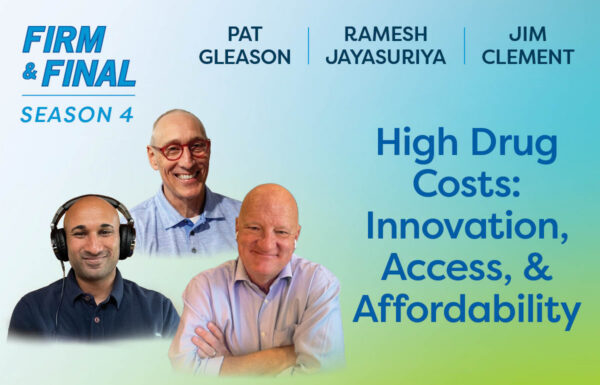
Joining us are Pat Gleason from Prime Therapeutics, Ramesh Jayasuriya from Evio, and Jim Clement from Synergie.
Together, we’ll have a very frank conversation where we try to define what constitutes a specialty medication, explain how value-based contracting and warranties work, and explore what the future may hold for pricing in the pharmaceutical industry.
And, each panelist will offer up what they see as some potential solutions to help improve drug affordability and access in the U.S. healthcare system.
Mehb Khoja
Hey everybody, welcome back to Firm and Final. I’m your host, Mehb Khoja. And today I’m joined by three of my friends that are also a part of the Blue Cross Blue Shield ecosystem.
As many of you know, BCS Financial is both a stop loss carrier and a reinsurer inside the Blue System. And today I’m joined by three of my friends.
We have Pat Gleason with Prime Therapeutics, Ramesh Jayasuriya with Evio, and Jim Clement with Synergie. And all four of us work for Blue Cross Blue Shield-related companies. And we all focus to a certain extent on high dollar drugs, especially those in the specialty space and the medical drug space.
And so I wanted to invite them today to have a conversation about high dollar drugs.
And as we get this conversation going, guys, I thought maybe it would just be good to do a quick intro about you, about your company, and specifically what role you play in high dollar drugs. Pat, why don’t we start with you?
Pat Gleason
Great, thanks Mehb. I’m a pharmacist. I work for Prime Therapeutics, a pharmacy benefit manager owned by 19 Blue Cross Blue Shield Plans, managing over 30 million lives with full service pharmacy benefit, Medicare and Medicaid commercial business.
My role is real world evidence generation to help with decision making and the development of formulary and utilization management products, clinical programs, measuring the impact of those and developing those, and negotiating value-based contracts with pharmaceutical manufacturers for discounts for their outcomes, not their market access type rebates, but those value-based contracts that pay back when the drug or gene therapy doesn’t work.
Mehb Khoja
Awesome. Ramesh, how about you?
Ramesh Jayasuriya
Good afternoon everyone. Ramesh Jayasuriya, I’m with Evio. Evio is a pharmacy services company owned by six Blue Cross Blue Shield Plans. Our sole focus is actually fairly simple. It’s all about making high-cost medications more affordable. And we do that through three primary levers. Think of it as three legs of a stool.
Leg number one is harnessing one of the largest longitudinal data sets that we’ve collected, as well as an investment we made in advanced analytics, both skill sets in people as well as technology, to identify the right medication for each individual patient.
The second lever, or the leg, is through innovative contracting models with manufacturers. Pat mentioned one flavor around value-based contracting. I’m sure Jim is going to go into a lot of detail around some of the great work Synergie’s doing. We also have a few unique flavors of how to extract value, and how to make sure that these contracts are equitable.
The last piece is really around a suite of digital health capabilities that underpin all of these components that I mentioned. My specific role at Evio is to lead two out of those three levers. I head up the first lever and the third lever at Evio. Great to be here.
Mehb Khoja
Awesome. And Jim, Synergie is still a fairly new company. What do you guys do?
Jim Clement
Yeah, thanks Mehb. Synergie is a medication collective representing most of the Blue Cross Blue Shield Plans across the country. We represent about 98 million lives in total, and we work on behalf of those Blue Plans to optimize their medical benefit and their drug purchasing within their medical benefit.
We also do some pharmacy access and network improvement for the Blue Plans as well as, you know, as Ramesh and Pat mentioned, we too do value-based contracting or innovative contracting models, more oriented on the medical side of the house. We have a handful of agreements, you know, we focus on the cell and gene therapies, as well as moving into some of the other rare disease therapies like autoimmune and myasthenia gravis.
Mehb Khoja
That’s awesome. And, you know, pharmacy costs have been front and center as of late. President Trump talks about pharmacy costs almost on a weekly basis. We see a lot of individuals like Mark Cuban coming into this space. I guess my first question is, why is the pharmacy space so complicated?
Ramesh Jayasuriya
Where do you want to start?
Jim Clement
Any number of ways we could take this Mehb. You know, I think it’s complicated. It’s expensive. And I think all three companies represented here or four companies represented here, we’re all focused on uncomplicating it and making it less expensive, if you will.
But the main drivers, I think, within the United States and the pharmacy supply chain is the innovation. The cost of innovation is high in our country, right? For every eight molecules that manufacturers study, one makes it to patients. And so there’s almost a hidden tax within our system for molecules that do reach the patient.
Mehb Khoja
Yeah.
Jim Clement
Right. And so to bring a drug to market when you account for failed trials, it costs about $2.5 billion. So, inherently, the system’s expensive.
Mehb Khoja
It’s very expensive. And we’re all working on ways to make it more affordable and accessible. Pat, why from your perspective do you think it’s so complicated and expensive?
Pat Gleason
It’s complicated for a number of reasons. One is that manufacturers set the price and there’s no check on that price. And they may say that it’s price to value for medical cost offset from a care of the condition and quality of life and caregiver support.
But their math doesn’t usually work. They’re overpricing their drug to value because the market will bear it, which is one of the reasons that Trump has created the Most Favored Nations directive, is because the price in the US is so much higher for most pharmaceuticals that are branded than anywhere else in the world.
So that creates a complication in of itself is affordability. But just our benefit design system in America is very complicated. If you’re an employer, multitudes of different ways to create a benefit and have cost-sharing and deliver that healthcare coverage with many different insurers in the marketplace as well as it allows the government paying for a number of lives.
Just those things create layers of complexity that we live with as Americans in our healthcare system.
Ramesh Jayasuriya
Mehb if I may jump in, I think those are great points. When I think about this question, the first place I go to is my mom is on Medicare, as of a couple of years ago. I think about her going to pick up a medication. Let’s not even talk about really complex things that would have to be infused in a hospital.
Just think about a normal medication that you pick up at a pharmacy. If you start thinking through the different factors that are involved, that ultimately determines how much she pays out of pocket, it is extremely convoluted because starting off with: what is the reference price?
And that piece alone, right, Pat you’re laughing. You know, Jim, like we’ve all lived in worlds where we’ve had to play a role in defining what the reference price is.
And that is an incredibly complicated factor because you got to know where they’re shopping. Right? Because if you’re picking it up at your local pharmacy or is it a chain pharmacy, community pharmacy, are you picking it up through mail? Price is going to be different. Do you qualify for a copay assistance program through the manufacturer? Is the reference price using average wholesale price or is it based on NADAC? Right?
I just threw two acronyms out there. And then you keep going, like you keep layering this out and you go, well, like how do I figure out what price I’m paying and what that’s based off of? And I haven’t even gotten into like really complex stuff that most of us deal with.
You know, especially you Mehb, when you come to really expensive cell therapies, gene therapies that are infused. Now, it’s not just the drug price, but you got to factor in the facility price. You got to factor in, you know, is there transportation required? So all of a sudden this thing becomes incredibly complex. I’m not saying it needs to be, but that’s the state we’re in.
Pat Gleason
Yeah, Ramesh I’ll just throw out ASP, average sales price. And then is the fee schedule on the medical benefit or is it on the pharmacy benefit to create your reference price. And you know who’s negotiated the discount on the medical benefit, on the pharmacy benefit. Yeah. And is there utilization management prior authorization, part of the whole thing. You know, just, easy question, very difficult to answer.
Mehb Khoja
I thought I would start with the easy question, Pat, and I guess maybe just kind of parlaying on that, is it more or less complicated in other countries? We always hear that like drugs are cheaper in other countries. And there’s so many companies that are set up today to import drugs from other countries because it’s cheaper.
So is it less complicated outside of the US?
Jim Clement
So Mehb you just hit on something that I think it was this week, maybe it was last week, but did anybody see the article in Financial Times, the interview that Pascal Soriot, the CEO of AZ did?
He was basically saying that, you know, there’s some recent policy out of Germany, right? And they’re looking at Germany and they’re looking at their investment in Germany as is like Eli Lilly and Boehringer Ingelheim.
They’re reducing their investment. And they’re starting to question whether they should launch drugs in some of the European countries where they can’t expect a reasonable price because 50% of their revenue is driven from the United States. And if they launch it in some of those European countries at an unreasonable price, it’s going to impact the United States pricing.
And so, I mean, you want to talk about complexity. It’s complex for major corporations. And as Ramesh just talked about, think about the patient. Think about his mother trying to navigate this. It’s horrendously complex.
Mehb Khoja
Yeah I agree with that. And there’s different categories of drugs. Maybe just for the sake of the audience you guys could explain like what’s a regular drug that you get at the pharmacy versus a specialty drug that sometimes takes you to a different place, right? Sometimes it’s through a specialty vendor. And then when you get to medical drugs, that’s a completely different ballgame.
Pat Gleason
I can take a stab at that. So traditional drugs are usually thought of as small molecule tablets, but not to say that every tablet is not going to be a small molecule of a traditional drug and not be a specialty drug, because that’s not true. And they’re going to be distributed mostly by your either mail order or your retail pharmacy network chains.
Specialty drug, interestingly enough, doesn’t have a definition. You think it would, but it doesn’t. You know, if you go Google or use your AI assistant now to look up, define specialty drug, it’s going to struggle.
CMS defines it purely on cost. It references to the cost of drugs as to the point in time in which the list is created, which is once a year. Right now it’s running about $1,000 a month.
So anything over $1,000 a month or $12,000 a year can be defined by the health plan provider as a specialty drug. Doesn’t mean it has to be, honestly. So you can also think of specialty drugs as meeting additional criteria besides costs. Limited distribution, so the manufacturer may not allow any given pharmacy to dispense it. It may only allow one pharmacy to dispense it.
Special handling is generally needed with specialty drugs in that they need to be shipped cold, for example, or other kind of specialty.
They’re typically injectable, but not always, as I said. Frequently they can be used or created as an oral tablet or other delivery mechanism.
But, you know, in summary, high cost is the primary reason, in more than $10,000 plus. But I’m sure we’ll talk about GLP-1s because you have to in any podcast about healthcare. So GLP-1s are wholesale priced at over $10,000. But they’re not specialty drugs by most health plan’s definition. But they would have met that criteria by CMS. So anyway, I’m sure somebody else wants to add color to that.
Ramesh Jayasuriya
Well I think you drew up a really great framework, right. Because what most people don’t realize is the fact that it is not a ubiquitous or a uniform term in the industry. I know Mehb you have a lot of employers and consultants listening to this that probably can relate to this struggle, because that’s one of the hardest things to parse through once you start figuring out how do I compare offer A from offer B.
Because that definition has a huge impact on your financials.
Mehb Khoja
And every PBM looks at that differently.
Jim Clement
Exactly. They’re not uniformly applied. It’s different by administration method. It’s different by delivery side of care. You know, a drug can cost in the outpatient setting, hospital outpatient setting, it costs 2 to 3 times what it could be at a standalone clinic. And that’s infinitely more expensive than delivering it at home.
And so certain rules only apply every leap year. Right. And so it’s hard to figure out based on as many belly buttons as out there, there is different benefit designs.
Mehb Khoja
Yes.
Jim Clement
So it’s really complex.
Mehb Khoja
And then we get to medical drugs like cell and gene. And cell therapies can cost a half million, $600,000. And that’s before a facility charge.
When you get to the gene therapies, these things are now priced at $2 to $4 million. How the heck are we in a time where a drug can cost $2 to $4 million.
Ramesh Jayasuriya
If they’re curative.
Jim Clement
Well, these drugs are, yeah, they’re bringing forward cures that we’ve never been able to do before. And when you, you know, the last 15 or 20 years have all been about asking the question “can we?” Clinically, scientifically, can we do this? Can we insert a functioning copy of a gene where a malfunctioning one exists?
And we’ve realized that we can and we can do it with precision.
The next ten years is really going to be about manufacturing. Can you manufacture these things at scale? Can you increase the prevalence of diseases that you go after with these and deliver cures in some fairly common disease states?
Mehb Khoja
Yeah, I think most of us feel pretty firmly that precision medicine is here to stay and is the wave of the future. But you said something there, Jim. We need scale. Scale can’t mean that all of these drugs are $2 to $4 million.
Jim Clement
No but what the current therapies have done is they’ve almost made the system a little bit numb to the price point, you know, three and a half, $4 million. Well, okay, then somebody comes out because they’re able to scale, manufacture it at scale and with appropriate distribution. Then all of a sudden, you know, maybe your cure for lupus is $1 million.
Mehb Khoja
Yeah.
Jim Clement
There’s a lot more patients though.
Mean there’s no there’s no getting around this. Yeah.
Pat Gleason
Right now they’re ultra rare. So as Jim’s pointing out, we’re talking about a membership of a population, risk of a gene therapy is in the 1 to 2 individuals per million, would you agree Mehb from an actuarial forecast?
I completely hope and not necessarily expect, Jim, knowing how manufacturers price, but hope that when we get to conditions that are 1 in 10,000 that they’re going to price their drugs fairly to a number that is, you know, substantially lower than the millions.
Our healthcare system can’t absorb pricing at this rate. If we get to a gene therapy that can treat diabetes, for example, which is in the pipeline, by the way.
So, you know, 1 in 20 people that walk around right now with type two diabetes because they’re overweight, maybe they won’t after having used a GLP-1.
But actually I want to just transition to that example, because that’s the problem we have right now with GLP-1 coverage for obesity. And we aren’t seeing it is because of the affordability problem. So you can translate the risk of future gene therapies if they don’t come down in price to what we currently are seeing, which is not every American has coverage for weight loss GLP-1 right now. Actually it’s the minority because of the price point.
Mehb Khoja
Yeah. Speaking about the price point. And when you think about spending $2 to $4 million on one of these drugs, what happens Ramesh, if the drug doesn’t work, is there like a mechanism where dollars get returned back to whoever paid for the drug?
Ramesh Jayasuriya
That’s where I was going to go. I think when you start thinking about scaling, there’s multiple areas that we’re tripping up. One of those is, yes, these are curative therapies. But remember these are studied on very small populations in clinical trials. They are new to markets, so whether you know it’s Pat looking at this or a couple of us looking at this from a real world evidence perspective, you’re still not seeing enough statistical significance to suggest that it’s a slam dunk, right?
So I think that’s one of the big issues that payers and employers are grappling with. It’s less about will I write a check for $2 to $4 million, because most people would want to do the right thing if you can cure diseases. And you’d want to do it.
The question then becomes the current system that’s set up today, it’s not set up to tackle those kind of financial challenges. It’s set up to dispense a few thousand dollars drug and keep that patient stable.
But all of a sudden when you get into multiple million, you have to amortize it over the next, well, typically the lifetime of that patient and you have to have some equitable warranty in place. And to me, that’s where Pat talked about this, Jim talked about this, I mentioned, we do need different types of agreements with manufacturers.
I think that’s where whether you want to call them value-based agreements, warranties, whatever the term you want to use, you have to have a way to tie this upfront financial exposure that you take on as an employer or payer to clinical outcomes.
And if those clinical outcomes are in line with the clinical trial and other claims you make as a manufacturer, of course you deserve every single dollar you got. But if not, then you don’t deserve those dollars because those should flow into something else that needs to keep that patient stable.
Because remember, some of these gene therapies, you’re still seeing the patients using the gene therapy, but they’re still frequently getting additional supplemental therapies because it hasn’t taken care of the problem.
Jim Clement
Ramesh I think you really you’re hitting on something and I’m sure everybody’s familiar with, you know, the FDA just came down in February. They put out a draft form I believe. But the plausible mechanism pathway. And that pathway is going to allow more drugs to come to the market more quickly in this caliber price range that we’re talking about.
And in these disease states that are rare but could have higher prevalence. And so that plausible pathway mechanism or plausible mechanism is, you talk about the pipeline and the flow rate of these approvals, we have eight BLAs for gene therapies outstanding right now under review over the next six to eight months. Eight.
Now, maybe six make it to market. Right. That’s still six. And the projection from ’27 to ’30 is probably anywhere from 12 to 20 approvals each year. So there’s no avoiding this. And it’s been, you know, since Luxturna came out in what, ’17? I mean, we’ve slowly been trying to craft a system that can deliver these to patients. You know, at the end of the day, these patients need help and they need these medicines, but it’s a system to absorb it.
Mehb Khoja
Yeah, it’s been at least since 2020 that Pat and I started talking about gene therapies. And I have to admit that the momentum in gene therapy hasn’t risen to the level that we all expected. We all expect that it’s going to come.
But really the big deal, and Pat you mentioned this, has really been GLP-1s in the past couple of years. So what’s a bigger deal today and going into the future, GLP-1s or gene therapy?
Ramesh Jayasuriya
Does it have to be either or?
Pat Gleason
I think the next couple of years it’s going to be GLP-1s. But I do think that’s going to subside because we’ve got two different manufacturers, the competition in the marketplace creating discounts. You have TrumpRX setting a price point that is substantially lower than what is the WAC price by about 2 to 3 fold, you know, and then other manufacturers are going to be entering.
The prices are going to come down for GLP-1s in the next few years. It’s going to take a little bit. But as Jim and Ramesh just pointed out, the pipeline for gene therapy is very robust.
There have been some setbacks here in the last few years, back in 2020. So in the last five years, some of the products have had adverse events, concerns. We’ve had a lot of learnings. There’s been some reluctance to administer and provide the hemophilia products, which were some of the originators for.
Mehb Khoja
That’s the first one you and I talked about. Yeah.
Pat Gleason
We can get into some details around that, but it might even be part of the revenue generation for the clinics that provide them, among other things. The hemophilia A product might not be as durable to the point of that’s why we need value-based agreements, because if they’re not going to hold, the therapy is not going to deliver on maintaining that factor level to prevent needing to have factory replacement, then that’s failure.
And you just invested a lot of money for something that didn’t deliver. So this first round of gene therapies, you know like you say, lots of learnings, more failures than we thought would occur in the market. But, you know, the manufacturers are going to overcome these. And the pipeline’s rich.
Mehb Khoja
Yeah. So I heard a lot of competition in GLP-1 will drive that pricing down. Do we not have competition in gene therapies? Is there not as much competition with like value-based contracts and gene therapies? Like what would it take to lower the price with gene therapies?
Jim Clement
I think it does take competition. It takes a degree of competition. Here’s the thing, and here’s why the value-based contracts are so important. Even when there’s an N-of-1, a value-based contract can make a drug compete against itself.
A value-based contract can make that drug perform to its clinical trial results. And if it doesn’t, there’s a revaluation of the cost-benefit equation.
And that’s why these agreements are so important. They don’t have to live in perpetuity, right. You don’t need to run. What accelerated approvals have done, particularly in the gene therapy space, is they basically transferred the risk, the clinical trial risk and the cost to the public, to the payer, whether that be the health plan or the employer. That risk is now transferred to that payer. And that payer has a right at Synergie, as Ramesh knows all too well because his organization does a wonderful job at adjudicating the contracts, but it’s a cost of entry.
If you’re a gene therapy and you’re wanting to be covered by the Blues, you’re going to need to bring one of these forward. Particularly as Ramesh mentioned, if you have a clinical trial of 12 patients and you got approved off of phase two data.
Ramesh Jayasuriya
Yeah.
Jim Clement
No way. We just can’t do it, right? We need to not only protect the financial health of the system, we need to protect the patient as well.
Pat Gleason
Yeah. I’ll throw in there Jim that to your point, like 12 people have phase two, meaning that you don’t really know if it’s going to work. And it wasn’t a comparator group that was tracked for many years. And that’s hard to do those studies.
Yeah. You know, N-of-1 trial again. And to your point earlier too Jim about accelerated approval process that the FDA has opened up. So we’re going to have more products that come to market with have been, gene therapies in particular, studied in numbers that are so small that you don’t know if it’s really going to work or honestly even be safe.
That leads to the health plan and the self-insured employer being able to make a decision of like, there’s just not enough evidence here, not medically necessary. I’m not going to pay for it.
If that’s the case, and we do have that scenario for one or two gene therapies right now in the market being decided that there’s just not enough medical evidence, then that’s even more incumbent upon the manufacturer then to bring its outcomes or value-based agreement to us to say, we’re going to give you money back or reimburse/remuneration for failure.
If you want coverage, priced at a number that is very large, with such tiny amounts of data, you must have these agreements in place with us.
Ramesh Jayasuriya
We’ve talked quite a bit about value-based contracts, but in the context of how do they help really expensive high-cost therapies. But if you take a step back for a moment and think about, you talked about federal government and state government pressure on drug pricing in general. Right. And there is a huge spotlight on how the current system is architected, where rebates play a huge role in that, I’m not one of those people that says rebates are bad because they have helped circumvent and keep premiums down.
But unfortunately, from a patient perspective, when you are paying your copay, co-insurance, off of list price, not after rebates, you don’t always see that, right? Because most of us are covered through our employer. It’s a deduction on a paycheck. We’re not making that determination.
So I do think over the next couple of years, these models that we’re talking about that are purely for ultra-high-cost therapies are going to be a factor, as there’s going to be more federal and state level scrutiny on current volume-based discounts.
So as volume-based discounts shift more and more towards outcomes-based discounts, I do think there’s a world where we’re not just talking about value-based or warranty contracts for these ultra high-cost drugs.
You may have them even for a drug that costs a few hundred bucks a month.
Mehb Khoja
Interesting.
Jim Clement
I agree Ramesh, I hope that’s the case. I just think in this country we do such a poor job at correlating price to value delivered. And the incremental benefit of successive therapies. These are on the margin that we make major leaps forward.
We’ve made major leaps forward with, you know, the cell therapies in multiple myeloma. Five years ago, the Kaplan-Meier curve was atrocious. And now it’s extended out 10 to 15 years. It’s wonderful.
Pat Gleason
Survival analysis. You’re going to confuse people. You’re really getting statistical on us Jim.
Jim Clement
Sorry, I’m not clinical and I’m not a statistician. So I just went way outside of my wheelhouse.
Pat Gleason
Most people aren’t going to follow…
Mehb Khoja
No that’s great. We want these drugs to work. And you know, I’m going to throw you guys a bit of a curveball question here. And look, I’m a stop loss and reinsurance expert. And I’m not in the space that you guys are as direct. But as I look at the stop loss and reinsurance space, that marketplace is struggling right now, to the point where we’ve seen three major players exit the stop loss and reinsurance space.
So the economics don’t work for everybody. I’m curious, from where you guys sit, is the economics not working for somebody where you’ve seen like a major exit or a major change in the company’s business?
I guess the one that comes to mind for me, Pat, is five/six years ago, we were talking about gene therapy and hemophilia, and today it feels like some of those major manufacturers have completely exited hemophilia gene therapy like BioMarin and some others.
But is there any other major players in your space that are just the economics are not working so they’re walking away?
Ramesh Jayasuriya
I’d say take where Pat plays. I mean, there are a lot of small to medium PBMs that are not going to survive. If you look at the regulatory pressure requirements and the fact that a lot of these smaller shops are sourcing rebates from the likes of Pat who’s on this call, eventually that’s going, they’re either going to be acquired or they’re going away.
Jim Clement
I agree with that.
Pat Gleason
Yeah also community pharmacies that are in rural areas. We have a high risk in this country of losing pharmacies that are in rural areas due to the economics of cost pressures and the volumes. It’s a volume problem that we have. They aren’t able to dispense enough prescriptions to make the margins they need to make to stay in business.
So we have to be really sensitive to how we design and reimburse healthcare. And that’s not just pharmacies, I should expand that to just healthcare in rural America, hospitals and health systems. So I started with pharmacies, but I’m expanding into all healthcare in rural America. Take a hard look at how we pay for our healthcare and ensure we can maintain access.
Mehb Khoja
Absolutely. Well guys, this has been a fantastic conversation. I’m going to get you out of here with one last question. If you could make one major change in the pharmacy industry, what would it be? Jim, why don’t we start with you?
Jim Clement
Does it have to be one? Can we go near term and long term?
Mehb Khoja
It’s a limited podcast interview today, Jim.
Jim Clement
There’s some systemic things that we need to solve, like patent reform I think would go a long way in solving long term. Honestly and Mehb close your ears, because as an actuary you’re going to flinch at this. But I think one thing that I would like to see in the pharmacy state in America is no copays for preferred products.
I think that would have multiple downstream ripple effects that would improve the benefit and the experience for members or for patients. I do think the insulin, lowering of insulin prices, that’s shown us that people that don’t want to take the drug don’t still, people that want to take the drug can’t afford it. It’s the margin. The people on the margin, which is a big group of people, now have access to insulin drugs.
So I would like to see preferred product co-pay waivers across the board.
Mehb Khoja
Okay, Ramesh, how about you?
Ramesh Jayasuriya
I think about this starting with the very first part of our conversation. Right. Why is this so complex? And one of the factors is we have so many players in between a drug getting manufactured and it is getting into the hands of a patient. And at each of those points, if you link their compensation to the price of the product, that creates distortion and that creates margin extraction opportunities.
So what I would love to see is de-linking of how the different industry players, whether you’re a wholesaler or whether you are a pharmacy benefit manager, service provider, etc., etc. everything is based on a transparent list price and then you get to earn more as you perform better. I do think that could create a massive amount of excess margins that can flow back into lower premiums, more affordability.
Mehb Khoja
Pat, you get the last word.
Pat Gleason
I’m going to build upon Jim’s but add a criteria. So if we’re going to have a $0 cost share, then we have to have a fair price to the products that it’s priced to value. So I’m on board with you, Jim. Like I want that too. But what makes it really hard right now is the fact that like GLP-1s are overpriced to value.
So and I can say almost every specialty drug is overpriced to value if, you know, rheumatoid arthritis and psoriasis are costing $80 to $100,000 a year, every cancer regimen that comes to market now is over $100,000. And many people take 2 or 3 of those regimens, maybe at the same time, or cycle through them to gain six months of life.
Every MS drug is over pushing $100,000. We can’t afford that. So they need to be priced fairly to value. And then we can have a cost share that’s zero for the preferred products.
Mehb Khoja
That’s what it comes down to, Pat. It’s about affordability and it’s about access to care. And I know that all of us are working very hard to make that happen. Because at the end of the day, this is an expense that’s borne by everybody in some way, shape or form.
So we’ll close it up there for today, guys. Thanks for joining me for this edition of Firm and Final. We’ll see you guys next time.
Listen on:




About the Podcast
Firm & Final: The Legends of Stop Loss and Reinsurance is an award-winning stop loss industry podcast from BCS Financial Chief Operating Officer Mehb Khoja. With a new focus each season, Mehb brings together members of the stop loss, reinsurance, and self-funded industries to discuss current and future stop loss issues and trends, and share legendary experience and advice for the next generation of stop loss and reinsurance superheroes.

Record and submit your question at [email protected] to be featured on a future episode!
Podcast hosted by Mehb Khoja: linkedin.com/in/mehbkhoja
Firm & Final Podcast
"*" indicates required fields