While the world of stop loss often focuses on mitigating catastrophic employer risk, supplemental health products are designed to protect the working families at the heart of those plans.
In this episode of Firm & Final, we explore these “two sides of the same coin,” examining how these two distinct product lines manage different layers of risk in an increasingly expensive healthcare landscape.
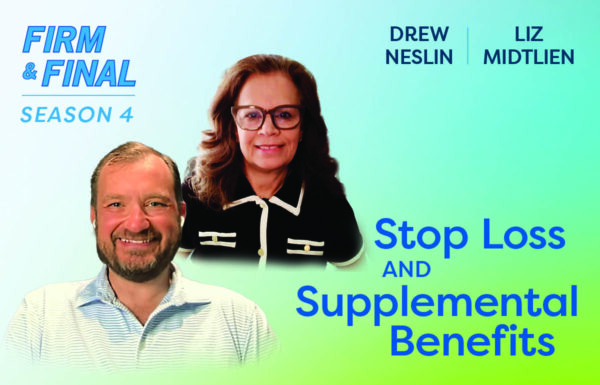
We’re joined by two of our BCS Financial colleagues: Liz Midtlien, Head of Large Claims Solutions; and Drew Neslin, Head of Supplemental Health Solutions.
Together, we break down the similarities and differences between these markets and how they can work in tandem to support both employers and employees.
Tapping into the depth of their individual experiences, Liz and Drew define some of the features that make supplemental insurance unique, explore the contrasting market challenges that the two industries face, and chart the potential for “claims integration,” where medical data is used to automatically trigger supplemental benefit payments.
Finally, our guests offer their predictions for the coming year, from industry consolidation and market exits to the “doubling down” on technology and transparency to better serve the needs of the modern workforce.
Mehb Khoja
Hey, everybody, welcome back to Firm & Final. I’m your host Mehb Khoja. And joining me today are two of my colleagues. We have Liz Midtlien, and Drew Neslin. And welcome to the podcast, guys.
Liz Midtlien
Thank you.
Drew Neslin
Thanks for having us.
Mehb Khoja
Yeah. This is going to be an interesting conversation because typically we talk a lot about stop loss.
And today we’re going to talk not only stop loss but supplemental health products as well. And you know whenever we talk about supplemental, I don’t think everybody really knows what the heck that means. Drew, maybe just start us off by telling us what are supplemental health products?
Drew Neslin
Yeah, it’s funny because with these products, they can be called so many different things.
I’ve heard it referred to as payroll products, worksite products, voluntary products, supplemental health products. Pretty much it’s anything that’s not medical, but it’s historically group voluntary, critical illness, accident, hospital indemnity. Those are kind of like the core three.
You can layer on other things on top of that. So like ID theft could be a supplemental product. Legal shield, pet insurance. But most people will recognize the big three as I call them: CI, accident, hospital indemnity.
Mehb Khoja
So Liz that’s very different for us, right? We’re typically working mostly on stop loss and sometimes on reinsurance.
Liz Midtlien
Right.
Mehb Khoja
And I would really like to spend the conversation today maybe kind of going into the similarities of these products and maybe more so the differences about these products.
So Liz, when we think about stop loss, what do you think are like a top 1 or 2 things going on in the stop loss market today.
Liz Midtlien
Well, you and I have talked about it and we keep continuing to talk to our customers about the fact that the claims are getting larger and larger. The severity continues to increase. And we’re seeing kind of a downturn in the performance in the stop loss market. So we’re talking to a lot of customers, as well as some of our peer competitors about, you know, is there going to be a rating increase adjustment that’s needed?
Or what does the future really look like? Because we’ve had a lot of market changes in the stop loss area as well. So just from a managing the risk perspective, we’re all starting to look at it a little bit different.
Mehb Khoja
Yeah. So I heard you say losses and loss ratios. And so that’s a challenging part of the stop loss industry today. Drew does the supplemental health products have the same loss ratio challenges that we’re experiencing in stop loss?
Drew Neslin
I wouldn’t say they have the same loss ratio challenges. They do have challenges in utilization.
And because the supplemental products are more paying to the employees and the members themselves directly, it’s getting the member to use it.
I think about, you know, what you guys are seeing around the high cost claims and the exposure there. The supplemental is about those things.
But for the member, higher deductibles, higher out-of-pocket maxes, those are the things that are impacting the employees and the members. And that’s really where supplemental is there. The challenge is getting the members to take advantage and using these products to cover those gaps.
Liz Midtlien
And when he says that, it makes me think of, you know, shock loss or the actual premise for having stop loss to cover those huge catastrophic risks.
But on the other side, the supplemental side gets to the employee’s ability to kind of smooth their financial risks in the whole game. So to me, I do feel like both products are addressing a similar situation or could like given the incidence of cancer that Drew was talking about, but at different levels.
So at the end of the day, if you talk similarities and differences, I feel like that concept of managing risk is pretty similar.
Mehb Khoja
Yeah. So that’s a good point Liz.
Let’s maybe take an example just to kind of dig into this further. Employer has $100,000 stop loss deductible. And they have a member that has a cancer claim, and that could be, you know, between $200,000 and $300,000.
So on a stop loss basis, they would get back, $100,000 to $200,000 reimbursement. The employer would. Drew, what happens in that situation where a member has a supplemental health product that covers cancer?
Drew Neslin
Yeah. So they would get an initial diagnosis benefit.
And at the time of enrollment, you know, they would elect the face amount, whether that’s $10,000, $20,000, $30,000.
And upon diagnosis, they would get that lump sum payment made directly to them.
That can help them, you know, with the out of pocket max or their deductible or the co-insurance.
It’s also going to help with a lot of the non-medical expenses that may arise. I mean, when someone has cancer, they still have to make their house payment. They still have to make their car payment. And that’s where that benefit can really come in and help them.
Liz Midtlien
You know, Mehb I have another similarity and differences, as you’re saying, that you’re talking about the stop loss deductible or the specific deductible that the employer buys. There’s also been a need to increase those deductibles on the employer side. But then the underlying benefit plan has also been increasing, as we all know, with high deductible health plans, etc.
So it goes right to what Drew was talking about, that both layers of risk from my side, or the way I see it anyways, can be supported by either product. So. Right. Right Drew? I mean we’re talking about out of pockets that we weren’t seeing years ago.
Drew Neslin
Exactly. I kind of look at it as two sides of the same coin. You’ve got the employer risk with the costs that are growing on that. They have to share that increased risk with their employees. You’ve got the stop loss for the large claims. That helps with the employer risk. Then you’ve got the supplemental health to help with the employee risk.
Mehb Khoja
Yeah. So this is a great way to start off the conversation. We started very technical. Right. But let’s maybe step back and tell me what’s so great about this marketplace and why Drew do you do you like working in supplemental health?
Drew Neslin
That’s a great question. Really, for me, it is about helping working families keep their homes, stay financially protected. There’s a lot of opportunity, to deliver a unique value with these products. They have evolved a lot over the last 20 years. You know, these used to be individual products, very customized, you know, heavily underwritten to the individual.
And as, we’ve seen deductibles go up, there’s been a lot of innovation and change and opportunity to educate the populace about what these products are and what they do.
And ultimately what they do is they help people keep their homes. And that’s what keeps me energized and engaged in this every day.
Mehb Khoja
Yeah. That’s great. Liz, how about you? What’s so great about the stop loss industry?
Liz Midtlien
It’s ever changing. And we’re challenged every single day. But, you know, the customers that we’re serving varying from employers to other health plans to creative financing solution like captives. Everybody’s looking to, I guess, right-size the risk to some degree.
So they’re making, each client is making an individual decision. So creativity is what really energizes me. And sometimes it’s tapping back into what we looked at in the 1990s. I mean, sometimes what’s old is coming around again.
So I think that’s honestly where we might be with some of the supplemental side as well. You know, the needs have changed and come and gone over the years.
Mehb Khoja
Yeah. And you just got back from a SIIA conference. So SIIA is an industry entity that puts on conferences and, you know, it’s where the distribution partners all come together, it’s where the capacity comes together to exchange ideas, learn from each other. I think you were a past president of SIIA some time ago?
Liz Midtlien
I was, yeah.
Mehb Khoja
Yeah. So, Drew, what’s available in the supplemental health world? Are there similar like trade groups like SIIA that bring together the different constituents, the carriers, the reinsurers, the distribution partners?
Drew Neslin
Absolutely. There’s a couple that come to mind. First is LIMRA, which everyone should be pretty familiar with, and they have very specific conferences when it comes to employee benefits. So the workplace benefits conference is a great one.
Another great organization is, called NASBI, the National Association of Supplemental Benefit Insurance. And that’s a great group of people that get together, to talk through what are the market trends, where are things going? What are the challenges that the carriers collectively face, and what are the opportunities that we have to improve as an industry?
Mehb Khoja
What about brokers? Do you guys work with similar brokers in the products that you place?
Drew Neslin
I would say we work with a lot of the same brokerage houses. We’re probably in different rooms from the stop loss brokers. A lot of brokerage houses, they have, you know, centers of excellence specific to different lines of business. So you might have a life and disability specialist. You’ll have a voluntary benefit specialist. You might have a stop loss specialist.
And so we are talking to a lot of brokers. They may not necessarily be the same brokers that stop loss is talking to.
Liz Midtlien
Hey, Mehb I’ve got a question for you. We can throw it to the group if you’d like. I’m wondering if there’s not consistency in the brokers that are placing these lines of business, why that might be happening? Are there different buyers within one employer? Why is the sales process different?
Mehb Khoja
You know, I spent a lot of time at Mercer in my career, and I know that’s one of the brokers that has a stop loss center of excellence. It’s got a different voluntary benefits center of excellence and even Life and DI. And I think it’s really because each of these products are very unique. And so you almost need an in sourced team that’s going to be like this small group of experts.
And that allows, like the producers that work at a company like Mercer to lean on this expert team. And you may have a client that needs to go through a stop loss marketing. You know, we think of stop loss as like an annual renewable, a lot of the voluntary products aren’t they, Drew, placed for maybe 3 to 5 years at times?
So maybe those RFPs don’t come up as often. And so the producers don’t have to be experts on these products that they have an in-house expert team.
Drew Neslin
You got it. A lot of producers have the center of excellence because they want that consultative expert when it comes to these types of coverages. And rate guarantees typically range anywhere from two up to five years on these products. The loss ratios are stable.
So you’re not really looking at rate increases. You’re more looking at, you know, service. How well are claims being paid? Is the billing accurate? How well is the interface going between the enrollment platform and the carrier?
So it is a little bit of a different selling cycle in that regard as well and the need to communicate and engage the employees is very different from other lines of coverage.
Mehb Khoja
Yeah. So, Liz, there’s got to be somebody in the audience who’s listening to Drew talk right now, and they’re going to reach out to you and say wouldn’t it be great, Liz, if stop loss had a 2 to 5 year rate guarantee? What would you say to that person?
Liz Midtlien
I would say that’s a great idea. I’d say we’d have a little bit of creativity to put into that as to figure out how that would actually work. But there is to me an element of sticking with a carrier and us sticking with, as a carrier, an employer for a period of time to help them manage their program and manage through the transition.
So I like the concept, if it can be done, it’s so traditionally done on a one year basis.
But it is, at the end of the day, a financing vehicle. So there has to be a way to be able to price for that or design for it. So I’m not going to say fully no to that. I’d like to hear more why? And then how actually an employer would or a broker would come to the table and design that. So great point.
Mehb Khoja
You’re not going to say no, I think our underwriting team would probably say no.
Liz Midtlien
Well, and maybe not. I said I want to be creative. So that’s why I’m doing this right?
Mehb Khoja
Yeah. No doubt.
I just think stop loss as a product is in a different volatility situation right now.
Liz Midtlien
Yeah.
Mehb Khoja
So the idea of offering like even a two year guarantee let alone two to five, Drew, it’s amazing how the voluntary products in the Life and DI can be held at those fixed rates for so long.
Liz, you mentioned that the stop loss market is challenged right now with loss ratios.
So what is the stop loss market doing about it?
Liz Midtlien
We’re addressing it from a number of different angles.
One of them happens to be, how can we help manage these claims and make sure that they’re being managed well from as early as an intervention as possible, all the way up to, you know, when they’re hitting a catastrophic level on the stop loss.
I actually thought before we started our conversation today that there’s some element of being able to, you know, use at that first dollar layer good cost containment efforts and good control. And ultimately, you would roll up to hopefully lower claims and better use of claims dollars. So we’re looking at any ways that we can to help be able to better predict what those claims are, but also to manage them from a cost containment perspective, or other creative solutions.
Drew Neslin
I think one of those points where there can be a connection between supplemental and stop loss is on cost containment.
One of the newer initiatives within supplemental health is looking at pharmacogenomic testing for cancer, specifically for a feature on a critical illness plan. And I think that aligns extremely well with, you know, with cost containment from a stop loss perspective.
You also mentioned something very interesting there, Liz, around first dollar claim data, getting into, you know, driving claims utilization for supplemental health. That’s another one of those points where if we’re getting the stop loss first dollar claim data in, we can leverage that to help drive better utilization on the supplemental products.
Mehb Khoja
So you’re talking about integrating claims data. That is a really nice feature, but it’s not widely used in supplemental health.
What does it take to get that going? Because that seems to be a really nice add.
Drew Neslin
It is, Mehb, and I would say integrated claims data is a moving target, even just defining what that is.
So a lot of carriers talk about it, but they talk about it in different ways. The gold standard in my mind is taking in medical claims data, turning around and sending out notification to a member that they have a potential claim, and then using that same claims data to adjudicate that claim.
But other people can say, you know, if we just notify, that’s integration. If we take a, you know, cancer diagnosis and hospitalization and we pay both a critical illness and a hospital indemnity claim, that could be considered integration. So the challenge as an industry is defining what does claim integration actually mean and what level of integration is meaningful.
Mehb Khoja
Now, is it easy or hard for us to get that data in order to integrate claims?
Drew Neslin
It depends on the type of data that we’re talking about. If it’s self-funded and it’s coming from a TPA, that’s the customer’s data. And they can direct that to be sent to a supplemental health carrier to ingest.
If it’s fully-insured and it belongs to the health insurer, that’s a whole other ballgame. That’s where you have to have a very close relationship with that organization.
And a lot more red tape to get through there.
Mehb Khoja
Yeah, that’s always been the challenge with this is getting to the data.
And Liz, we have challenges getting to data as well in stop loss. I know a lot of times we want to be able to audit claims, but we can’t always get the information even though the group is self-insured.
Liz Midtlien
Right, right. We face that every day depending on the administrator who’s actually administering the benefits for the employers that there’s a limited data set available, they are saying that they’re protected by their contracts with the providers. They don’t want to disrupt that relationship.
And so very often when we’re talking multimillion dollar claim, we’re going to want to at least look at the hospital bill and compare it to the care that was given and was it appropriate?
So we’re a second set of eyes as a stop loss carrier to make sure that the right processing was done on the claim and that there was actually diligence paid.
So we can’t get that very often. And therefore what ends up happening is in our industry in general, talk about the severity issue on the stop loss side, there’s more potential for us to be paying claims that aren’t 100% necessary, or validated. So it is perpetuating the problem. The lack of transparency in the data we’re using to pay the claims.
And it’s resulting in carriers and industry partners taking a different, harder look or maybe even a harder stance on the processing of claims.
And so you talked earlier about what levers are we using to control these claims?
Fortunately or unfortunately, some of our competitors take the perspective of, where can we not pay a claim?
And it just makes it really challenging for all of us in the industry as well. So that’s not what the coverage is designed for.
But we’re also challenged with having enough information to make an educated decision.
Mehb Khoja
So a lot of high dollar claims, loss ratios are challenged. Drew, what are some of the challenges that you’re facing in the supplemental health market?
Drew Neslin
Yeah, it’s a lot more of the upfront type of work, I would say, getting hosted on to a benefits enrollment and administration platform.
Every carrier has some platforms that they’re already hosted on that they might not be.
It’s a lot of file eligibility stuff.
It’s a lot of legwork at the very beginning. I think that’s part of why there are those two to five year rate guarantees, because it can be really difficult, a very cumbersome process sometimes to implement these coverages.
And so there’s not a lot of appetite to try and move that. The other side of this is we do have loss ratio challenges. And it’s educating and engaging the membership to understand the benefits that they have. You don’t have to face that in stop loss, but with supplemental health, you have to convince the membership on the value of the products and then remind them to submit the claims.
That’s where the integration piece becomes so important. But it’s also happening at a time where data privacy and security is increasingly paramount.
Mehb Khoja
Yeah. And what about the regulatory side, Drew? I heard that there’s some lawsuits that are happening in the supplemental health space.
Drew Neslin
Absolutely. So historically, these products have been very profitable for insurance carriers. There’s been very low loss ratios, a lot of profit there, a lot of commission dollars for brokers. And, you know, brokers like to work with specific carrier partners. You know, they’ve got their preferred vendors.
But that can be a problem when you’ve got a select number of carrier partners and there’s low loss ratios and high commission dollars.
And if it’s an aggressive plan, you can see you’ve got the right ingredients for some pretty challenging lawsuits.
Liz Midtlien
And on the flip side, we have to bring up the stop loss margins and the stop loss profitability per se. Those margins have been really compressed over the years. So it was never that, at least in my experience and in my time in the business, never the level to which Drew expressed, but, we’ve been pressed further and further by a lot of entrants into the markets over the years, and a lot of people interested in being in the stop loss space and a lot of competition that have put rate pressure and downward pressure on retentions and deductibles.
But the short story being, there’s not a lot of margin there for anywhere to go other than to be able to increase the rate and look at different structures.
Mehb Khoja
That’s a really good point. And, Liz, I heard you earlier talk about transparency. And transparency in both stop loss and in voluntary benefits, you know, you think about voluntary benefits. It’s usually about the commission payments. One of the things we’ve seen pop up on the voluntary side is the use of captives. Drew I wondering if you could speak to that a little bit.
Where do we see captives coming into play for voluntary benefits?
Drew Neslin
Yeah. So captives are really a way to shine a light of transparency onto the voluntary products, disclosing everything under the sun, whether there is an implementation credit that has to get paid to get set up on a platform to what claim dollars were actually paid to members versus what wasn’t.
Normally in a traditional, you know, group voluntary perspective, there’s maybe an annual stewardship meeting where claim dollars and loss ratios are shared, but not a whole lot of greater detail.
In a captive situation, the employer has a much greater line of sight into how it’s working, where those claim dollars are being spent and what the overall expenses are looking like, whether that’s brokers or platforms or anything else.
Liz Midtlien
So not to get too technical, Drew, on captives, but how are the groups organizing to go into a captive in that space? Are they single large employers that have a captive vehicle, or is it a collection of like-minded employers?
Drew Neslin
So there’s a there’s a few options out there.
There are captive organizations, basically captive managers that have this, that market specifically to large employer groups for them to participate.
There may be others that decide to just do it on their own, it tends to be more upmarket.
For employer groups, down market, you know, they really want to stay within the traditional fully insured space.
Liz Midtlien
And down market in the stop loss space, the self-funded space has grown in popularity so much over the last few years. And we’re seeing captive solutions on the small group, really to make that entry into self-funded easier. But yet it still has a captive complexity, which we could also talk about for an hour or so.
So just interesting perspective on how you’re using captives versus what we see on the pure health side.
Mehb Khoja
Yeah. And at the end of the day it is about that transparency. And it’s about trying to get that cost as low as possible for the employer groups and for getting the cost as low as possible for these members.
And so we’ll probably start wrapping it up here soon. But I was wondering if you guys could just share something that you see happening in your industry over like the next 12 months?
Liz, why don’t we start with you? What’s something that you expect to see different out of the stop loss market, and maybe even the reinsurance market over the next 12 months?
Liz Midtlien
Yeah and the obvious one might be I do expect that there will still be some consolidation or potential exits. With the losses being what they are and it being fairly consistent across the industry, the reinsurers and the large ones, some international are going to have to restructure their position and how much risk they want to take in the US healthcare space.
So even last week at SIIA, Mehb, there was a number of London reinsurers and brokers over visiting and you know, from my perspective, the London market tends to kind of come in and out. So that tells me that there’s still interest in coming in. But yet I think I would we would expect some additional consolidation. And the other thing that there’s a lot of talk about is talk about being transparent, visiting with your customers.
So if you’re a broker or a health plan or a TPA that’s starting to prepare for the renewal cycle, there is a certain amount of preparation that should be done. And talking about, you know, what to expect at renewal, it’s going to be another year, very likely January of ’27 that will see some increases again.
And, you know, all the reasons why as well as consulting with those buyers on, are they taking the right amount of retention? I mean, it’s no different than the first dollar when you’re having that decision of whether you’re going to have a $1,000 deductible or a $3,000 deductible.
So there’s going to have to be some adjustment to get back to a new normal from a rate and a profitability perspective. That’s how I’m seeing it.
Mehb Khoja
Yeah. Thanks for that. Drew, how about you? What do you expect to come out of the supplemental health space over the next 12 months?
Drew Neslin
I think we’re going to see, you know, a doubling down on the efforts to do the claims integration piece. And part of that is due to the lawsuits that are going around, you know, employer groups want to see the value in these products.
For carriers, that’s going to represent a challenge. They’re having to balance paying high commissions to brokers, paying technology fees and getting higher utilization on these products.
So I’m predicting that in 12 months, we’re going to see more streamlined and transparency on broker compensation as well as platform fees, in addition to the improvement and the doubling down on the claims integration.
Mehb Khoja
Yeah, that’s great. And as for me, I’m going to say that there’s going to be a lot more integration or a lot more bundling of stop loss and voluntary benefits.
There’s some other carriers out there like BCS that have both of these products. And you know, they’re aimed to the same employer groups and a lot of times distributed through the same brokers. And I think there’s a lot of value in packaging these products together so that both employer and member get the benefit of them. And so I do think that those carriers that are in both of these products, they’re going to work extra hard to find ways to distribute them at the same time.
And so with that, we’ll close it up for today.
Thanks for joining me on this episode of Firm & Final, and we’ll see you next time.
Listen on:




About the Podcast
Firm & Final: The Legends of Stop Loss and Reinsurance is an award-winning stop loss industry podcast from BCS Financial Chief Operating Officer Mehb Khoja. With a new focus each season, Mehb brings together members of the stop loss, reinsurance, and self-funded industries to discuss current and future stop loss issues and trends, and share legendary experience and advice for the next generation of stop loss and reinsurance superheroes.

Record and submit your question at [email protected] to be featured on a future episode!
Podcast hosted by Mehb Khoja: linkedin.com/in/mehbkhoja
Firm & Final Podcast
"*" indicates required fields