Even veterans of the stop loss industry are scratching their heads these days, wondering if this is the hardest market with which we’ve ever had to contend.
With loss ratios peaking at 91% last year and widespread underperformance across all segments, insurers are struggling to keep pace with the accelerating trajectory of high-severity claims. But big premium adjustments risk alienating customers.
So in this episode, we’re discussing these trends with three veterans of the stop loss industry, and exploring opportunities to stabilize and sustain the stop loss marketplace moving forward.
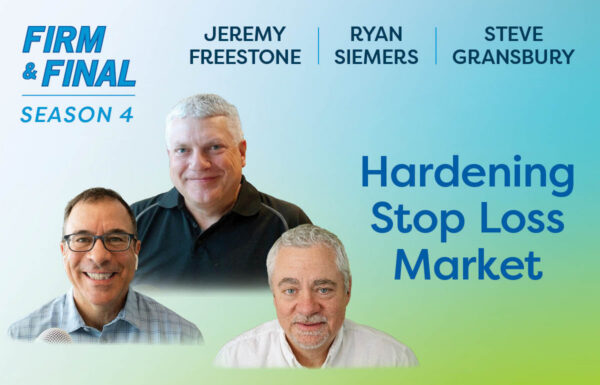
Joining us are Jeremy Freestone from Symetra, Ryan Siemers from Aegis Risk, and Steve Gransbury from Captive Resources.
With their insights, we’ll explain the current market’s repercussions for the growth of self-insurance, the increasing impact of new technology on the underwriting process, and four potential solutions to button up margins as we head into the next year.
Mehb Khoja
Hey, everybody, welcome back to Firm and Final. I’m your host, Mehb Khoja. And today we’re talking about things that are happening in the stop loss industry. I’m joined by three awesome guests today.
We have Ryan Siemers who’s the founder of Aegis Risk, Jeremy Freestone, who’s the senior vice president and P&L leader of stop loss at Symetra, and Steve Gransbury, who is the president of health solutions at Captive Resources.
As I get us started today, guys, I got to think we are in a very crazy market. You guys have been around stop loss a very long time. Do you remember a time that is as crazy as the one that we’re in today? Steve, why don’t we get started with you?
Steve Gransbury
Late 90s, believe it or not. Just a couple years in the business and we had a dramatic hardening in the market where we had much more capacity exits than what we’re seeing now. We had a reduction in acquisition costs, like commissions were being limited.
Again, I was just early in my career, but I remember it well. But I haven’t seen anything like that since, and I think we’re on our way to a real hardening market, but I still think there’s a bit to go in terms of capacity and maybe some contract kind of ring fencing around certain terms.
Mehb Khoja
Jeremy, how about you? Have you seen a market like this since you’ve been at Symetra?
Jeremy Freestone
I don’t know if I’m younger than Steve or what, but I haven’t seen anything this crazy personally.
I mean, loss ratios in 2025 reached a new all-time high, just over 91%, and that was on top of an all-time high the previous year.
The loss ratios have been, for the market, have been in the 80s or so since 2019, I would say, but for the first time it went over 90% in 2025.
And where it’s going to go in 2026? Hard to say, but it sure still seems like employers are dealing with tough renewal increases and marketing. So that’s crazy and that high loss ratio has led to some dynamics I hadn’t seen before in terms of how many clients are asking for brokers to shop their business this year, more than ever. And clients themselves are unhappy with what those initial quotes are looking like. And some of them are deciding to move on to new brokers. You know, maybe we can find someone else who can get a lower.
So, I’m seeing more turnover there. You’re seeing later decisions than before. I know when we were tracking how January business was going, at first it was like, “No one’s making decisions. Is this us? Are we not going to sell any business this year?”
But it was late, you know, it was a very late cycle as employers kind of waited and let some more months come in as a way to improve, hopefully, what they were seeing as a really tough review. So yeah, I haven’t seen it like this before. I mean, it’s as hard as I’ve ever seen.
Mehb Khoja
And Ryan, you’re tracking this in your annual survey of stop loss rates. I mean, at some point you’re going to have to raise your graphic up so that the rates can go even higher. But have you seen a market like this since you’ve been tracking your work at Aegis?
Ryan Siemers
I can’t say that we have. And that survey is in its 20th year. You know, it predated the Affordable Care Act. So initially we used to ask what’s your lifetime maximum on your specific. And only 20% had unlimited. And usually that was a health plan stop loss over health plan. So, I have not seen this. It is a good retrospective you can see.
And we tried we show year over year for the prior year. But we were looking back and in ’21 to ’22 to ’23, were soft with no surprise to anyone there. So, you know, it’s definitely a comeuppance and we all know the basis behind that. But no, we and I think this one upcoming cycle will be, I think last one was a bit of a surprise to many broadly in the market.
And now they’re aware and I think there’s still more shock that will come.
So, a time to be smart. And I think it’s going to change some, as a broker intermediary, it’s going to have to change some established practices at renewal time that really weren’t sensible in the first place. And so, it’s going to be interesting.
Mehb Khoja
So, I heard a high loss ratio, Jeremy you said 91%. I heard some changing of brokers. I heard market dynamics that we haven’t seen in maybe 20 some years. So, are we really in a hardening market?
Steve Gransbury
The only thing that I think is missing from this, this hard market, and it’s kind of interesting; our comments were all about like, “It’s tough out there.” A lot of broker challenges. We’re already seeing tough renewals, we’re already seeing a lot of shopping. We’re not in the January 1st season yet. So just think about the point in time where we’re at now.
We’re not in January yet. But I think the only thing missing from a true classic hardening market is dramatic capacity exit. There’s certainly been some key reinsurers that have left. But other than capacity exit, this is every quantifiable indication of a hard market.
Jeremy Freestone
One thing I would look at as a way to try to understand how to answer that question is, is it happening in pockets or is it happening more uniformly across the board? So, when you look at loss ratio information from the NAIC, it is a record loss ratio of 91%+ in 2025.
But when you dig into that, the BUCAs were at new all-time record loss ratio. The third party was at a new all-time high loss ratio. If you dig into the third party, the third party with captives, a new all-time high loss ratio, the third party without captives, a new all-time high loss ratio.
So, I think it’s across the board and that is going to point to a hardening market or at least a maintaining of where the market has been so far in this, because it’s not in a pocket where brokers or clients can take advantage of. It’s everywhere.
Steve Gransbury
The other segmentation, Jeremy, is that the segmentation of the MGU community, the carriers that provide capacity, their loss ratio the last couple of years, you know, certainly not on target, was actually running a little bit better than the independent carriers. If you segment the most recent NAIC report, the MGU space is actually ticking up as well.
Ryan Siemers
And I’ll add, and Steve brought up capacity, I too feel like that’s, as I understand it, a component of a true hardening market is that capacity is also diminishing or remaining flat. And I think when you look at it, there’s still writers looking to write business. So you’ve got that avenue, you’ve got group captives, you’ve got level funded, which you know, is a parallel risk approach. Which is, you know, giving options in the market if you will.
But I think it’s as much a focus back on discipline and a correction. And I think maybe, perhaps coming out of COVID where we had that pause in high claimants. But we believe some of those undiagnosed cancers have come around now in roost.
Renewals back three, four years ago, maybe writers could be a little more liberal because they were looking at their recent loss ratios and saying, “Hey, we’ve got it, let’s keep this business.” But it came around and then snapped hard as we all know, particularly there in late 2024 and still through today.
Mehb Khoja
Yeah, that’s a really good point, Ryan. And when I think about our industry, there are a lot of really smart people in this industry. And some of those smart people are saying it’s time to exit. At the same time, there’s some really smart people saying it’s time to enter.
Help me get into the mindset of how do you make a decision to exit a marketplace at the same time there’s individuals making a decision to enter this market?
Steve Gransbury
Perhaps some would say there’s no better time to enter a market than when it’s is correcting, right? Because you don’t have the baggage, you don’t have the loss ratio and in your experience, you know, significant rate rise.
So if you look at where is the state of the market, if the market truly is in a period of profound remediation, where more attention to technical underwriting, in our space more attention to large claims, more attention to just the quality of the case, if there is widespread remediation, where there’s a push both in terms of rate and technical rate or rate to manual, then some would say potentially, “Hey, this is a good time to get into this space.”
Perhaps if I’m a P&C carrier, I’m still looking for short tail cover diversification within my book of business. I don’t have this baggage. Maybe now’s the time we jump in. Perhaps.
Jeremy Freestone
I think there’s a lot of attractiveness for stop loss too. I remember seeing a McKinsey exhibit that showed what the EBITDA projections might be for different group benefits product lines over the next five years or so, and stop loss is one of the big ones on there. It enjoys a growth rate like very few insurance lines have. Just from the natural leveraging of medical trend.
You got to keep on top of that. I mean, we’re seeing record loss ratios despite 10 to 15% average rate increases. And that’s not enough to keep up on claims trajectory. But I think there’s appeal to it because it’s annual contracts. It’s not super capital intensive relative to some other lines. So I think insurers look at that and think, well, that might be a good diversification play, but it is a tricky market to succeed in long term.
And I think you see that with carriers trying it out and then deciding to exit after a few years, you do have to have the right specialized mindset to succeed in a long term view.
I would say on the capacity front, just to circle back to that for a second, one area I do see a capacity constraint happening, and it’s not so much with exiting carriers.
It’s brokers are having a hard time getting quotes because the decline rates are up really high. This was an all time high for decline rates from what we could tell based on feedback. So there’s a capacity issue there, especially for some clients that may have had a rough year or something. Brokers had a really tough time finding quotes for them.
Ryan Siemers
And to build off of that on some of those comments, you know, back on potential new entrants.
And I think this applies to a lot of brokers too, who maybe before were not as focused on stop loss but now they have a center of excellence, is they’re drawn by the leverage trend premium increases. And what rises with those premium increases?
Boy, if there’s a fixed percentage override, that goes up just the same, that’s a dynamic that I don’t think a lot of policyholders are quite aware of.
Mehb Khoja
Ah, commission payments!
Ryan Siemers
Yeah. So that premium volume I think is appealing to others out there.
And Jeremy makes a good comment there on I mean, I heard that from all of our reps last year. One of our reps at a direct writer put it, he was saying to me, “What is that at the emergency room, is that the ‘triage nurse?’”
And I said, “Yeah.” He goes, “You know, when you walk in the door, I have 40 RFPs a day coming in right now. I’m maybe working on 15 or 20 of them.”
And we’ve always, Aegis Risk, we’ve always had pride in our RFP packets. We don’t send them out until they’re ready to go. And we may work with a broker partner or direct with the plan sponsor.
Oh, we’re annoying to make sure we get the right claim reports before we give them. I mean, I think that may not necessarily always happen with the volume of proposal quotes today is that they’re packaged and ready to go.
And I think that’s going to be one of those awareness for the broker community this upcoming season is, hey, make sure your packets, as we’ll call them, are complete. Have notes, have clinical, have IDs, because otherwise the volume is so high they’re going to put that in the DTQ pile and move on to the ones that they can move on.
Mehb Khoja
Volumes are absolutely high. I think it’s a factor of what Jeremy said, that a lot of employers with their brokers are shopping because they want to see if they can get a better rate. So that’s one piece of it. The other part of it is just like the organic growth of self-insured employers. And a lot of this is happening down market.
So, a lot of these smaller employers who are fully insured are moving to level funded and small group captive solutions. Why do you guys think that that space is so attractive for smaller employers?
Steve Gransbury
I’m not sure if it’s just smaller employers. I think it’s larger employers now, specific to the group captive space. And Jeremy kind of alluded to this in the opening, is that you’ve got a group that might be caught flat footed with a rate increase and a broker that might not be prepared for delivering that rate increase.
They got through the renewal, they got through the midyear check in, and they’re like, oh we’re budgeting 7.5%, but you know, you’re running well, but maybe you should kick that up to 10% or 12% because of these things going on in the marketplace. They get delivered their renewal and it’s 21%. It’s 19%. They have been self-funded for three years. They’ve had great claims experience. And the broker kind of walks through, “Well, there’s a lot going on in the marketplace and this is where rate to manual and discretion is.”
“This is what an area factor is. I know your experience is good, but the carrier might be going through remediation. You’re trying to solve a lot of problems with the weight of their book of business.”
And then you kind of get that response from the from the client that says, “That’s kind of not my problem. Like, I’ve got a good experience. I’ve got to look at alternatives at this point. I got to look at group captives. I have to look at maybe changing my broker. I have to maybe look at a consultant. I have to look at point solutions. I have to look at risk engineering.”
So I think it’s not just germane to the struggles that smaller groups have, but it’s the same dynamic in this particular market with larger groups as well.
Similar things are going on in the fully insured space. Just as a barometer, if you look at the max rate filings for ACA small group providers, they’re significant. I mean, those are groups only 50 lives and under but those are dramatic rate filing indications. So you have to see it happening with larger fully insured groups as well. They’re caught in that same position.
How can I manage this rate increase? What else can I be doing to handle this and manage it? Not for this year but for the next several years.
Mehb Khoja
So, Jeremy, when you look at the RFPs that are coming in at Symetra, do you see a growth in any particular size segment of those RFPs?
Jeremy Freestone
Probably more in the smaller like under 500 lives space is where you’re seeing more employers asking for a quote, and you have fully insured employers looking to go self-funded for the first time that are kind of interested in seeing what‘s a quote looks like in that space.
I will say I would love to see more customers avail themselves of the advantages of self-funding.
You know, I’ve tried to understand in a stop loss market where premiums are going up 12% or 13% a year. How much of that’s inflation and how much of that’s new customers coming in? Because ultimately, as we try to grow our book, I don’t want to grow the premium but shrink the customers. I’d rather grow both.
And so, keeping your eye on the customer count, I think is an important element to see how well is your strategy coming along.
And when you look at that, I think of that 12% to 13% increase that we see, it’s only like a couple percent that’s coming from new customers entering the market. I’d love to see that higher actually.
Mehb Khoja
Interesting. Ryan, how about when you’re collecting data for your survey? Do you see that the respondents are growing in any particular size segment?
Ryan Siemers
I can’t say we’ve observed that. It always has, in our survey, amongst other things, it does a line curve that fits to every deductible, a premium rate downward sloping curve. And there’s obviously a more preponderance between $100,000 to $250,000; a lot of dots and then it kind of thins out. And we also look at deductible size versus employee size.
So it reflects that, I would say probably, and the survey gets direct plan sponsors. It also gets broker and some writers who submit data points. The data set definitely has a very sizable, let’s say sub $200,000 deductible grouping, which I think reflects the market, particularly some of those broker data points we get.
But I think too, it’s, you know, the dynamic, we helped a consulting partner self-fund two groups last year. One was 1,700 lives. Another was 3,500 employees.
Mehb Khoja
And they were fully insured?
Ryan Siemers
They were fully insured. And you know, this partner that we work with does a good job, they’re sort of oversight is a good way to put them. And they were working with national firms, and there was hesitancy to move them from the fully insured platform. And we did it. Now those are good sizable groups. We got good reporting.
But, you know, one thing I noticed a lot, too, is there’s a lot in the market who are hesitant to go get a 12/12 quote for the first year. And we don’t get a whole lot of data points in the survey because that is unique. That’s a first year transition.
But even working with some broker and consulting partners, they’re hesitant. They want to get a 12/15. And you know we said, well you don’t really need to sell. We committed to self-funding. Let’s go with that. Let’s get to 12/12. It’s going to renew the 24/12. But I still think that that initial, I think we do a good job of selling to the underwriters. Hey, this is a group we want to self fund.
But I still think that that initial stop loss quote is, as everyone knows, tricky. And I think we’re a group captive platform, and oftentimes do a very good job of holding that hand and having a complete setup that transitions someone to self-funding.
But I still think getting that initial stop loss quote is still a tricky acquisition for that first time.
Mehb Khoja
Yeah. Makes sense. What about the role of technology, guys? Where do you see technology advancing in the self-insured and stop loss space?
Jeremy Freestone
Well, I’m seeing it in different areas along the work stream. So, quote ingestion is a top area where you’re seeing technology. That’s a very manual process a lot of the time. So, is there anything that can be done to streamline that? I’m seeing AI-assisted underwriting tools proliferate and grow in capability, and the kinds of things they could do.
There’s also pitfalls to navigate in those solutions that you’re seeing. Carriers, even clients, you know, I’ve seen quotes come in where the client says, “I don’t want any AI used in my process if you’re going to generate a quote.”
You know, so you’re seeing kind of a backlash start to emerge on some of that. Portals are coming out.
So, I think there’s a proliferation of technology solutions going on, which is going to change our market landscape pretty significantly here shortly.
Steve Gransbury
Yeah, I’d agree. I think it’s a good insight. I think the submission clearing space is low hanging fruit. There’s some decent solutions out there. There’s some great homegrown solutions with carriers and MGUs and that’s an area that gives ultimately carriers and underwriting organizations some expense lift over time, right, because they’re managing their portfolios on a combined operating ratio, loss ratio being the primary contributor to that.
So, if you can save a couple of points on your expenses, literally in a combined operating ratio basis, you can have better performances, like taking points off your loss ratio.
And I’m not sure if it’s and I’m probably not the person to comment on this, the submission clearing technology out there, I’m not sure if it’s machine learning or true AI, but it is effective and it’s relatively inexpensive and it’s incredibly scalable.
Mehb Khoja
Yeah. Why has this been a market that’s been driven by like RFPs over email for so many years? Like, why is that archaic process kind of stayed in place in this particular industry?
Steve Gransbury
I think it’s unwinding a bit because you see just a massive facilitation of like the centers of excellence and so forth. So, you’ve seen it kind of a level out or concentrate. But I think that, you know, on the EBC, on the employee benefit side, you’ve seen like the broker also be the person who places the coverage.
And I think what you’re seeing now with a lot of the larger houses that aligns with the P&C model is brokers consult and teams place coverage.
And so when teams place coverage outside of the local office or the local broker, you start to see efficiency and you start to see technology.
Mehb Khoja
So like a transactional side of a broker consultant house.
Ryan Siemers
Yeah I’m glad Steve brought that, brought up that model instead of myself speaking as the broker. But you know, we actually do not use a generation model yet. We use online file folders in that.
But, you know, every submission is unique. And we still, as I put it, we like to sell the risk. I say stop loss is like a property casualty.
You know, you have to convince the property casualty underwriter to take the risk. And benefits has too much of a mindset of, “Oh, here’s my RFP. I’ve got seven days on it. I’m gone. I want to see it next week and walk away from it.”
I may be oversimplifying, but I think that mindset still dominates in an employee benefit world there.
But I think using technology, what I’m intrigued with is, and this might bring it back more to the writers, is if there’s technology that you can do more predictive modeling under a changing health care environment where perhaps looking forward into year 2 or 3, you can have a better sense of where your book might be, where your pricing needs to be.
I have a former colleague of mine who’s with an entity that is looking to explore that model. It’s pretty interesting to see what they might be able to do. As she put it, an actuary, God bless actuaries Mehb, but they’re good with a fixed environment perhaps, but a modeling, a changing environment with many variables can be maybe difficult into the future.
But how exciting could that be is if the market could actually support like a 24 month policy. We’re not saying a fixed cost for 24, but has a guaranteed renewal ability because at the same time, one of the attributes of stop loss, it is such a short contract period you have to commit to as a policyholder, but also as a writer.
But I think that’s part of the pickle the market is in right now is, could a longer coverage period benefit both ends of the scale? And could that type of predictive modeling, no one’s looking to take the past recent high claimants and be comfortable to go more than 12 months. But if you have a modeling solution that could support that, that could be a new dynamic.
Mehb Khoja
Jeremy, your thoughts on filing a 24 month policy?
Jeremy Freestone
I think there might be versions of that filed in existence out there by some carriers, although I don’t know if I’ve ever seen any actually sold. Maybe. But yeah, it’s tough because of how high the leverage trend is, you know, so I think carriers have struggled to figure out how to make it work.
If you want to get in the load necessary to protect yourself for that year or two period, then usually you put some of that in year one and then that makes you uncompetitive typically.
So employers are basically making the decision that they would rather have the better deal now with one year than, than pony up the extra for two years.
Mehb Khoja
And then push their broker to fight for a better renewal rate. I think I’m with you on that. And Jeremy, I want to pick up on something else you said in the technology question. You talked about AI underwriting tools, and these have grown very quickly in the past few years, but so has self-funding and so has loss ratios.
So what do you guys think about the underwriting tools that are out there contributing to the loss ratio problems that we see in the industry? Are they helping or are they hurting the problem?
Steve Gransbury
Well, that’s a loaded question. I think. Yes. I think it’s a little bit of both. I think the technology has come an awful long way. And it’s true, AI for the most part, I think I think it’s come a long ways. The access to the clearinghouse data, especially for groups who have weak experience or no experience, it definitely flags scenarios.
But unquestionably, when you do like a blind study of a couple of these different tools, you do get differences and you do see hallucinations in both models.
I think it’s a lot better now. The technology has come a long ways, but I still don’t think it’s there yet. I think it can assist the underwriter with a selection, but I don’t think it’s a tool now that can replace any part of the process.
I think it’s a great tool at disposal, but still it’s just not quite there. An effective tool for sure.
I think it’s probably helped more than anything in terms of identifying something that’s not in the experience, it might be a fully insured transitional case. This is “Okay, I should be really, really concerned about this. And maybe I should ask additional questions. Maybe it should be a decline. Maybe it should be, you know, that I need additional terms.”
But has it helped the business write business? I think perhaps in the wrong hands that to rely on it has probably contributed to the loss ratio. But from my experience, I think it’s helped kind of avoid or treat unknown large claims that might not be readily available in the RFP, whether it’s in the census or disclosure.
Jeremy Freestone
I would agree. I think if you’re overly dependent on some of the new tools out there, it can get you into trouble. And I think prudent pricers use the tools as a perspective that they want to take into account and can help them sharpen the pencils on some quotes, but you got to have some guardrails in there because these things aren’t really proven out very well, you know, and I think some history shows that sometimes they work, sometimes they don’t.
And I’ve looked at some of the claims databases and things like that, that power some of the tools that are available. And there’s question marks that come up when you look at those. So, you know, what’s the quality of the bounce backs that you’re getting from some of the different hits, I think is a legit question.
So I think it’s a valuable perspective. It’s great if you have it, but if you’re totally dependent on it, I think you could be asking for trouble.
Mehb Khoja
Yeah, it’s basically one more data point that should be incorporated as part of the underwriters’ view. But I think we can all agree that the traditional approach to underwriting stop loss is probably going to stay in place for some time. We’re probably a long ways from this underwriting process being fully automated, no human interaction at all.
Ryan Siemers
I have sometimes said as a stop loss broker, it is my role to claw down from manual rate as much as possible on any quote we get, and that’s a conversation which I’m trying to understand through the rep, potentially through the underwriter. You know, where can we play? How can we convince otherwise? And I think that supports, Mehb, what you’re saying is it’s still an art to get to that price and a dialog which needs to occur.
Mehb Khoja
Sure. Well, guys, this has been a great conversation. I want to get you out of here with one last question and take some time to think about this, but you guys are all experts in this space, and certainly this industry is being challenged right now.
Look into your crystal ball and tell me what needs to happen in order for this industry to sustain and essentially fix where we are today.
Ryan, why don’t we start with you?
Ryan Siemers
Sure. You know, there’s a simple one. And I think there’s a couple of change in mindsets.
One, groups, policyholders and their advisors need to be prepared to index their deductible each and every year. A “no change” in deductible is a buy up. It is not an expectation.
And so the coverage winds up incurring too much as a total of the health plan cost, if it’s unchanged. And so I think that’s a mindset and that will solve if there’s even a modest indexing 5% a year, which is below trend, but I think will make this a more sustainable model, an expected model moving forward.
Mehb Khoja
Great. Steve, how about you?
Steve Gransbury
The market by and large on the traditional stop loss side needs to remediate. We’re just simply not getting enough rate to be a sustainable market. So we talked about risk selection and underwriting. There’s rate tools out there. But it’s a bespoke business a specialty business in the sense that there’s very high severity but relatively low frequency. I think in this market we’re seeing too much frequency.
But when you have that dynamic in place, it has to be an underwritten product, fully underwritten, and the market by and large needs to push rate and needs to remediate. The other piece is that groups and brokers that have the luxury and the benefit of clients right now that have good experience, that can change tomorrow. But if they have good experience right now, we need to see the market further embrace alternative risk structures.
The captive space just offers certain groups the opportunity to create a risk structure with captive reinsurance. But really, with member owned captives, really manage them almost like first dollar programs. The risk is reinsurance, but the conversation is about what are we doing to mitigate claims, what are we doing with optimizing the plan risk structure?
And I think that’s got to be part of the solution as well. But overall, the market needs rate and continued evolution in embracing alternative risk structures.
Mehb Khoja
Jeremy, I’ll give you the last word.
Jeremy Freestone
Well, just to build on one of the last comments there Steve made, it’s on the cost trajectory, you know, I mean, how many cycles can we go through asking employers to pony up 20% plus leverage trend, you know, and then raise your deductible too, so that it can come in a little lower than that?
Like there’s only so many times I think you can do that sustainably without triggering some sort of discussion around what are we going to do to bend this cost inflation curve down some.
And I think this last cycle, with the magnitude of the surprise of how high the increases were, did trigger some of those conversations. We saw more willingness to talk about cost containment than usual, more willingness to explore the captive options or other things that employers did not really have as much inclination to look into in prior cycles.
They were this time and I think that can continue to build. So I think the market is crying out for something to help bend the cost curve down some.
Mehb Khoja
I agree with that. Cost containment is definitely hot right now.
I think when you think about insurance premium, our insurance premium, the cost of goods sold is the cost of hospital contracts, the cost of specialty drugs.
And brokers and consultants who are taking a deeper look at the cost of goods sold, I think they will win in the long term, because if you don’t attack that piece of it, it’s really hard not to raise your rates. Steve is exactly right. You need to get rate.
So I think cost containment, the cost of goods sold is the area of focus for 2026.
We’ll see how things shake out. It will be a very interesting January cycle. Maybe I’ll have you three back and we’ll talk about it again in 2027.
But until next time, thanks for joining for this edition of Firm and Final.
Listen on:




About the Podcast
Firm & Final: The Legends of Stop Loss and Reinsurance is an award-winning stop loss industry podcast from BCS Financial Chief Operating Officer Mehb Khoja. With a new focus each season, Mehb brings together members of the stop loss, reinsurance, and self-funded industries to discuss current and future stop loss issues and trends, and share legendary experience and advice for the next generation of stop loss and reinsurance superheroes.

Record and submit your question at [email protected] to be featured on a future episode!
Podcast hosted by Mehb Khoja: linkedin.com/in/mehbkhoja
Firm & Final Podcast
"*" indicates required fields