The dynamics between selling stop loss policies and underwriting stop loss policies have always created a strange dichotomy in the stop loss industry.
But the latest NAIC data show loss ratios in stop loss climbing to an astounding 91%.
And, in an environment where both of the severity and frequency of claims are on the rise, this added pressure is being felt by everyone.
So in this episode, we’re speaking with sales leaders from throughout the industry about the implications of these loss ratios, how sales strategies are evolving to meet the new market realities, and the impact of continued broker consolidation.
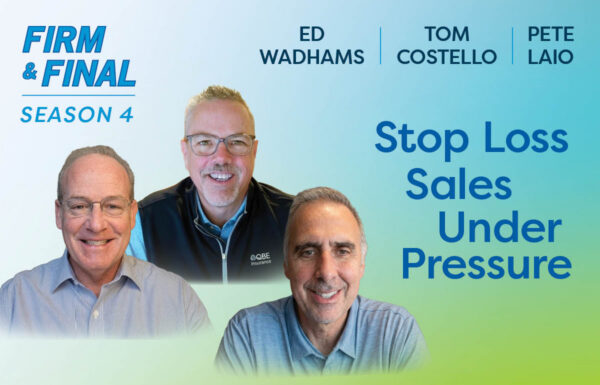
Joining us are Tom Costello from Symetra, Ed Wadhams from QBE, and Pete Laio from BCS.
Together, we’ll discuss trends in self-funding, captive programs, and the move away from fully insured models, as well as new approaches to balancing profitability and growth in a high-loss environment.
And all our guests will make sure to share their predictions for how these dynamics will impact us in the year ahead.
Mehb Khoja
Hey everybody, welcome back to Firm and Final. I’m your host Mehb Khoja. And today we’re talking all things sales regarding stop loss. And I have three great sales leaders with me here today. We have Tom Costello with Symetra, we have Ed Wadhams with QBE and my good friend Pete Laio from BCS.
And so guys, just last week we saw from the NAIC that the new loss ratios in stop loss are out and they’re up to 91%.
How do you guys, as sales leaders think about that? And how does it make your job in selling this product more difficult? Ed, why don’t we start with you?
Ed Wadhams
Well, it’s definitely challenging. I think it’s territory that we’ve not quite seen before. Going back to probably early summer, we started to see an uptick in claims in terms of frequency and severity. And that’s continued. So, you know, the NAIC data that came out, it’s actually confirming what we’ve all kind of felt and see in our own books of business for the last several months that claims costs are up both in frequency and severity.
Pete Laio
I’ve expected this for quite some time, and there is always an anomaly with somebody like, you know, that has like an outrageously good loss ratio.
But now you’re seeing, you know, the Plans, Aetna, United, Blue Cross, now have a huge uptick in their loss ratio. So the carriers themselves are feeling it as opposed to just, you know, just the stop loss carriers.
You know we felt this. We live it daily, yearly, annually. You know it goes without question. But now you’re starting to see where these, you can’t offset this with, you know, with premium. It’s real. And that’s what’s scary.
Tom Costello
Yeah. I think from our perspective, it was people that were used to getting good renewals, single digits, rate passes, or finding carriers quoting below current, like that seems to have disappeared. And so the producers are not used to this.
And it’s really a lot of education because they’re finding they’re either not getting quotes, they’re getting a lot of DTQs or what they get stinks quite frankly, as compared to a current carrier. And so that education process is probably what makes this harder is to explain it’s not just us. There are a lot of people in the same boat and that, you know, you’re not going to get competitive quotes, especially if your group is running poorly.
Mehb Khoja
Yeah, I think that’s very true, Tom. And like I said, the NAIC came up with these loss ratios just maybe two weeks ago. But if we kind of move back to January 1 time frame and think about the NAIC results from a year ago, they were at 86%, which I think that made January a difficult time for most stop loss carriers, because we were all putting out larger rate increases than we’d like.
How does that conversation go with your top distribution partners as to why you need to make such a big adjustment in rates?
Tom Costello
I think a lot of people, when they see the frequency and severity of large claims, they’re not surprised. It’s when you have that odd group that doesn’t have any claims through June or July, and they don’t understand why you’re giving them a rate increase. So really, it’s a lot of education to tell them what’s left on the balance of the year is 75-80% of the claims. Like you’ve seen nothing through June or July. You really have the back end coming.
But I think as far as like this past cycle, it just was, and like QBE, we had seen a huge uptick in claims in the summer. So fortunately or unfortunately, you had some claims that you could show people that, yes, there’s multi-million dollar claims already hitting and it’s only July, so get yourself ready for a rate increase.
But the ones that didn’t have claims that was still a hard discussion, but the ones that had claims they’re already showing it. It was a lot easier story to tell.
Ed Wadhams
I think that’s key. You got to be able to tell the story right, but you need to be able to explain to that producer why you’re asking for what you’re asking. What’s driving the increase? What are the claimants of concern that you’re seeing?
The more information that we can give to a producer, the easier it is for them to get in front of a policy holder to have that conversation. But if you’re just handing out a blanket increase of X and not providing them with the how or the why, it really makes it challenging for our producers.
So that’s something that we really try to drive home with our underwriters and our business development system: overcommunicate, give them the information that they need to help make our case, the reason why we need to increase that we’re asking for.
Mehb Khoja
Yeah. And I mean, I gotta think, Pete, we’re talking to similar distribution partners that every other carrier is talking with. Do we hear the same sort of feedback from the producers, or do they have like a different take on what’s happening in the market?
Pete Laio
You know, it is becoming more apparent in the marketplace, I believe. Before, it was always hey, they’ve got a 0% loss ratio, even though you’ve got claims that are incurred, but they haven’t been reported. And we all know, like we have to prepare, you know, from an underwriting standpoint, we have to prepare for the upcoming year for these claims to hit.
You know, they want to show their worth, so to speak. And part of that worth is delivering a relatively palatable type of increase.
What I’m seeing now with the brokers, it’s really starting to change. And now it’s a give and take with the carriers as far as a partnership. So it’s not like, hey, have mercy on me, but hey, how can we work together?
And I’m starting to see more forthright in regards to like, hey, let’s work on a cost containment solution. How can we start to leverage these deductibles so that way they are prepared for when large claims start to hit. So I’m starting to see that with our friends on the broker side.
Mehb Khoja
Yeah. You mentioned cost containment, Pete, and I got to think Ed and Tom, that’s a conversation that’s got to be happening with every producer now.
Ed Wadhams
Absolutely. And it’s challenging because when you look at the vast majority of the market being administered by a commercial carrier in some shape or fashion, it’s tough to bring those resources to bear because they’re not going to stop the adjudication process. So if we do identify something, it’s: do you have the time to get that producer engaged, the employer engaged, to bring a solution that you can put into that process.
And that’s the challenging part of it is because those ASO carriers are not going to stop the adjudication process to allow cost containment from an outside stop loss carrier to get involved.
Tom Costello
Yeah. I mean, I would agree, it’s very hard to interject yourself into that, but I think more and more producers are recognizing they have to do something because that infusion that’s going to go on for years now is creating a difficult situation at renewal.
The market won’t touch it. And you know, will your no new laser and rate cap protections still be in place as a result of this large ongoing claim? So it’s no longer just a stop loss carrier’s problem. It’s the employer and the broker’s problem to come up with some kind of solution when you have these runaway, for example, the infusion claims.
Mehb Khoja
Yeah for sure. And we’re getting into that time in life now where there’s $2 million to $4 million cell and gene therapy claims. And it feels like that momentum hasn’t fully come into the stop loss world yet. But if it’s coming, that kind of spells trouble for an industry that’s running in the 80s and 90s.
And it used to be that brokers were telling groups that you should go self-insured because you could save money.
Do you guys think that there’s going to be a change in brokers telling groups to either stay fully insured? Do you think that there’s going to be a change in like the momentum towards self-insurance?
Tom Costello
I think there’ll still be a lot of momentum for it because the fully insured increases are just not sustainable, you know, because that’s 20% to 30% to 40% on a on a huge premium number. So even self-insuring when there is some risk out there maybe with gene therapies or cell therapies is a better deal longer term than it is fully insured.
So I don’t see that changing. I just think there’s more conversations about do I need to cover cell and gene therapy or gene therapies? Can I carve that out of my plan? It’s always a scary conversation to have someone thinking about doing that, but it’s not unusual now to have people say they’re going to do that.
And so there are ways to do it. And self-insuring is only way you can really do that, where you would carve out gene therapy from your plan and not cover it. So there are creative ways to do it, it’s just those are challenging conversations.
Pete Laio
I think there’s a lot of humility that’s going around. You look at the carriers, our competitors, there’s a there’s a handful of competitors that have dropped out of our space.
And so there’s putting more pressure so that business has to go somewhere. And there’s a reason why they dropped out is because their loss ratio wasn’t good or they, their shareholders just said, hey, enough’s enough.
Obviously, that risk is now going to be spread over, call it a smaller pool. Now you’re seeing these big carriers like they just can’t wash their risk away, you know with a fully insured premium. Consultants are starting to realize that. So for the first time in the conversations that I’ve had with a handful, and we all do business with the same folks, they’re taking a step back. They’re saying, hey, listen, there is carriers out there that are pulling their no new laser rate caps, not all of them, but there is a handful of them out there that are doing that.
Never heard that before, and there’s not a lot of dismay. It’s almost an understanding, an unspoken word, so to speak, from these houses. I also see, and I’ve heard from a handful of brokers where they’re talking about more of a fixed fee, something based off of leverage. That has never been spoken about before. So I am starting to see movement.
Mehb Khoja
I think you’re right, Pete. I think there’s a lot that’s changing with the brokers right now and another way that they’re changing is there’s a lot of consolidation that’s happening with the brokers. You see some of the bigger firms buying smaller mom and pop brokers. Ed, how does that impact the stop loss industry when that happens? That type of broker consolidation?
Ed Wadhams
It completely changes distribution. I mean, the merger and acquisition frenzy wasn’t just a year or two. I mean, each year 2017, 2018, 2019, each successive year in terms of mergers and acquisitions broke the prior year’s record. Even during the pandemic, we saw, you know, large retail brokerages purchasing others. I mean, there was a lot of activity. And what’s happened over time is what I would classify as almost a super regional firm has gone the way of the dodo.
I mean, there’s still some out there. They’re still a number of firms that want to be fiercely independent and do their own thing. But mergers and acquisitions have really reshaped distribution more so than we’ve ever seen. I mean, I’ve been doing stop loss since 1995. When I got into this business, I started out on the brokerage side, and we were kind of an anomaly.
We were one of the few brokers that our responsibility, we thought was placing stop loss coverage. When you think back then, probably 75% of the business was placed by third party administrators. The other 25% was retail brokerages. Well, now fast forward to today and that’s flipped. I’d say it’s even more so. It’s probably 80%, 85%, maybe even 90% broker placed.
And 10% third party administered place. It’s changed dramatically. And all that business via those mergers and acquisitions has been aggregated to several players. And, you know, you look at a Gallagher Benefit Services, highly acquisitive view, every time you turn around they’re making an acquisition. So I think acquisitions really you know hit a fever pitch. But then you know last six, eight, ten months, it started to slow quite a bit.
Money’s become more expensive to borrow. And a lot of folks are just kind of watching and waiting I think, you know, there’s still some acquisitions to be made, but it’s not nearly at the pace that we saw two and three years ago.
Mehb Khoja
Yeah. Tom, what do you think about broker consolidation?
Tom Costello
The consolidation really I think has been on our end has probably been pretty beneficial because we’re fortunate enough to be a preferred market for most of those that are acquiring. And so all of a sudden we pick up an opportunity, you know, because we don’t have 100 sales reps, like we might find out, oh, there’s a broker they just bought in Kansas City that has 25 stop loss cases.
And so that’s an opportunity we may not have seen just because we don’t have enough distribution sometimes. And so those have been all positive since we have built great relationships with the firms, it just sometimes means it’s more expensive, right. You’re maybe now paying an override that you weren’t paying before. And that’s the part you have to kind of grapple with each time that they buy up somebody that was maybe a smaller regional.
Mehb Khoja
Yeah. Is it easier to do business with smaller regional players that don’t have all the bells and whistles of, like, the large national brokers?
Tom Costello
Yeah, I mean, I think so. I think they rely heavily on a since they, they’re a generalist, right? So they have to know life, dental, disability, medical, a little bit about stop loss, vision, you name it. So they need stop loss expertise. So if you have good reps out there, they really rely on you. And so you become more of a consultant, you consult the consultant, we like to say.
And that’s helpful because you’re also dealing with a direct decision maker. There aren’t a lot of layers at these places that you need to deal with. So it’s usually a very positive experience for us and them. They may not generate $100 million in sales for you, but what they have, they’ll be loyal to you and they appreciate what you bring to the table.
Mehb Khoja
Yeah, absolutely. Absolutely.
What about like the growth of small group self-funding? We talked a little bit earlier that there’s a lot of momentum in self-funding. A lot of it is coming from down market. And these groups are going with like a level funded product or they’re going with a small group captive. We’ve been hearing lately that some of those small group captives and level funded programs are not very profitable.
They’re not operating at the levels that they would like to, but they have done a really good job of getting employers to move toward self-insurance. What’s like the momentum or what’s the growth in small group captives and level funding, in your opinion?
Ed Wadhams
We definitely see the growth in our small group captive program, those groups coming from fully-insured to self-funded. We’ve definitely seen an uptick there. I think those make sense when it’s an employer that wants to control the risk. A lot of times we see folks that, you know, mention the “C” word “captives,” but they’re looking for that captive solution when the health of their group is not where it should be to be in one of those high performing type arrangements.
We’ve also seen an uptick in single parent captive opportunities. So an employer that already has a captive established, whether it be for medical malpractice or worker’s compensation, they can take that existing captive and utilize that to fund the medical stop loss risk as well. So we’ve seen that on both sides.
Tom Costello
I have some concerns about the size of some of the groups that are going into these programs, especially the level funding, that could be ten lives going level funded.
And, you know, the industry will start getting a lot of scrutiny from the regulators because it’s a way to get out of a fully insured risk pool. And all of a sudden those pools start to deteriorate. So I have concerns about the down market stuff.
And then the captives, I think, the ones that think it’s going to cure their five cancer claims, like they’re just going to disappear if they go into a captive. I think there’s some education that’s probably missing for that because it’s not the silver bullet for a group that’s running poorly.
Mehb Khoja
I definitely agree. I think there’s some groups that are too small for self-funding. I remember when I was at Mercer, we would tell groups that were less than 400 employee lives, like, you should be fully insured. And certainly the opinion on that has changed. I think groups as small as 100 employee lives are thinking about going self-insured now because they want the data and they want to have access to their claims.
It makes a lot of sense if you’re working with like, the right type of broker and consultant who can explain all the new things that you got to think about, if you go into self-insurance. But it’s definitely not for everybody. And Pete, I know when we get smaller groups coming through our underwriting cycle, we tend to just move on from them because we don’t have the data to quote on it.
Pete Laio
Yeah, it’s difficult. Clearly, if there’s a large claimant there, you’re going to be upside down. You’re not going to be able to collect enough premium for a long period of time. And, chances are, once those groups get rid of that large claim, they’re going to move on because they can’t absorb the renewal that we’re going to give to them to try to recoup that premium.
It’s just it’s not going to happen.
I think there’s, you know, obviously we’ve got the consolidation. But, you know, when you start talking about the captives and really in essence, work comp was the original originator, so to speak. And it was always like businesses that they had in a captive and they shared the same values and they shared the same… Everything was regulated by OSHA.
So they put all these different processes in place to make sure that people were safe and they weren’t slipping and falling. And it’s not that I see captives growing, but I see more, I see on the horizon more of that, you know?
Mehb Khoja
Like a specific captive.
Pete Laio
A specific captive that shares the values. Those values are going to be cost containment. Those values are they’re going to say, if you come into this captive, this is what you’re going to have to do. You know, everybody’s got to fill out a health assessment survey. There’s going to be subsets of doctors that they themselves are going to start to drive cost or try to affect cost.
Ed Wadhams
You have to be of the mind that you want to control the risk. If you’re self-funded, you have that mindset. I want to be able to kind of dig in my experience and address problem areas and control risk. If it’s a small group that’s entering a captive environment it’s the same thing.
It’s like if you were that employer that just kind of was in the fully insured market and you take the rate increase year in, year out and you want to have a hands off approach, then a group captive… It’s just not the hope for you.
Mehb Khoja
Yeah, it makes total sense, Ed. So guys, this has been a great conversation. I’m going to get you out of here with one last thing. Like we said, the loss ratios are up in stop loss. So I expect a lot of healthy tension come this January 1 between sales and underwriting.
And so just give me your thoughts on the dynamic that’s going to occur this January when you’re bartering with your underwriters for rates for your client. Why don’t we start with you, Tom?
Tom Costello
Well, one of the things that makes us a little unique is we pay our reps on profitability as well as new business sales. So the tension that’s there is generally not “I got this ugly case and I want to sell it no matter what, with four Hemophiliacs,” it’s more about like how can we look at this group creatively.
So I think it’s more positive conversation to be honest with you, just you’re trying to find a way to write a case. And now lasers are, people are more willing to take lasers on which three years ago, they didn’t want to even talk about that “L” word. But now they are.
So I think bringing creative solutions or feedback or even bringing in cost containment helps underwriting and sales, you know, find a way to get through this season and be successful.
Mehb Khoja
How about you, Ed?
Ed Wadhams
I think you’ve got to have underwriting and business development work in concert. You got to collaborate. We all are given the same marching orders. It’s like we all need to deliver underwriting profit. And, you know, we need to grow the top line. It’s so important to focus on obviously top line growth, but you have to focus on profitability. You have to focus on retention as well.
It’s almost like you’re juggling those balls in the air and you can’t afford to take your eye off of one to the devote too much time to the other. So underwriting is responsible for delivering a loss ratio result that makes sense.
Our business development folks are as well. We want our business development folks to think like underwriters. We want our underwriters to think like business development folks. It’s like there’s an art and science to both sides of that equation.
But at the end of the day, we need to write new business. We need to write profitable business. And we need to write business or retain business at a rate that can promote that profitability long term.
So that’s going to require both underwriting and business development. I’ve always heard the term kind of dynamic tension, but I’ve always kind of shied away from it a little bit because you really need to have both folks at the table, and one can’t win over the other time after time, because that’s not a good result either.
Mehb Khoja
Pete, we’ll give you the last word.
Pete Laio
Well, it’s an underwriting world these days. When loss ratios are good and rates are cheap, boy, you’ve got sales guys out there buying new cars. And that is, I don’t want to say it’s a world that we won’t see. But the playing field, you know, when you start talking about underwriting and sales, to Ed’s point, we all have to row the boat in the same direction.
You’ve got loss ratios, you’ve got retention, and you obviously you want to retain the brokers that write that business with you. So you’re going to be working renewals just like you’re working new business. You know, it’s for the good of the organization. So I truly believe that it’s here to stay because, just the magnitude of the claims, they’re not going away either.
Mehb Khoja
I think you’re right on, Pete. And, that’s where we’ll close it up for today. Thank you for joining this edition of Firm and Final. We’ll see you next time. Thanks, everybody.
Listen on:




About the Podcast
Firm & Final: The Legends of Stop Loss and Reinsurance is an award-winning stop loss industry podcast from BCS Financial Chief Operating Officer Mehb Khoja. With a new focus each season, Mehb brings together members of the stop loss, reinsurance, and self-funded industries to discuss current and future stop loss issues and trends, and share legendary experience and advice for the next generation of stop loss and reinsurance superheroes.

Record and submit your question at [email protected] to be featured on a future episode!
Podcast hosted by Mehb Khoja: linkedin.com/in/mehbkhoja
Firm & Final Podcast
"*" indicates required fields